
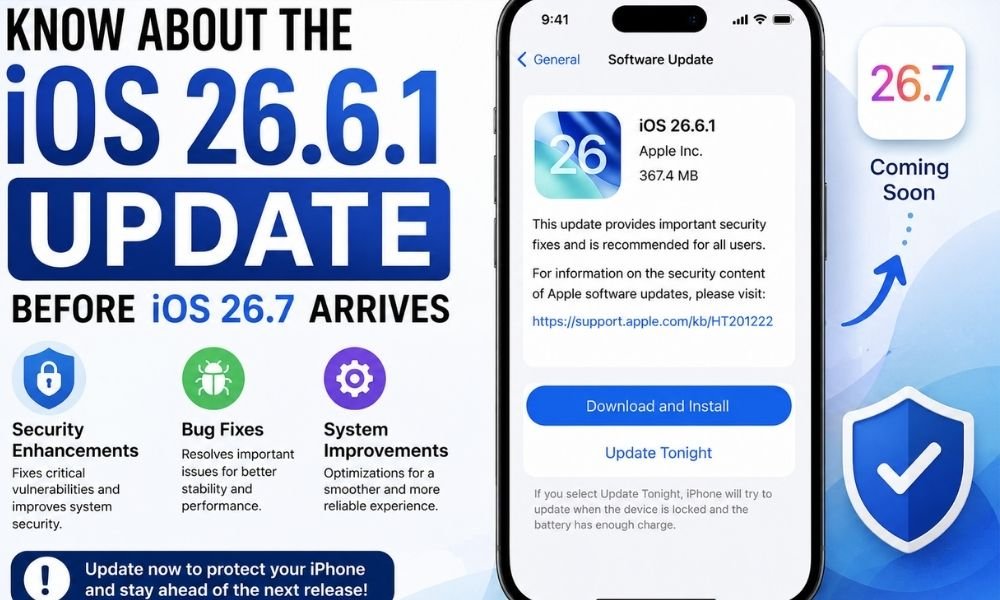
Apple has released iOS 26.6.1 as an important security-focused update for compatible iPhone models. Unlike major iOS releases that introduce redesigned interfaces and new user-facing features, this update primarily focuses on strengthening system security, fixing vulnerabilities, and improving overall stability.
According to Apple’s security information, iOS 26.6.1 addresses 29 security vulnerabilities across several important components of the operating system. The largest number of fixes is related to WebKit, the browser engine used by Safari and many applications that display web content. Other security improvements address the kernel, ImageIO, graphics, audio, telephony, and additional system components.
Although iOS 27 is expected to bring major new features, iPhone users running iOS 26 should not overlook iOS 26.6.1. Security updates such as this are designed to protect devices against vulnerabilities that could potentially be exploited by malicious applications, websites, files, or network traffic.
iOS 26.6.1 Fixes 29 Security Vulnerabilities
The most important aspect of iOS 26.6.1 is its collection of security patches. Apple has addressed vulnerabilities affecting different layers of the operating system, ranging from the browser engine to low-level system components.
The fixes cover:
- WebKit
- Kernel
- ImageIO
- IOGPUFamily
- Audio
- Telephony
- WebKit History
- WebKit Storage
- Other system frameworks
These vulnerabilities have different levels of impact. Some could cause applications to crash, while others could potentially result in memory corruption, information disclosure, denial-of-service conditions, or arbitrary code execution under specific circumstances. By addressing these weaknesses, Apple aims to reduce the possibility that specially crafted content or malicious applications could compromise an iPhone.
WebKit Receives the Largest Number of Security Fixes
The largest portion of the iOS 26.6.1 security update focuses on WebKit. According to the available security information, around 21 vulnerabilities are associated with WebKit-related components.
WebKit is an especially important part of Apple’s software ecosystem because Safari uses it to process websites and web content. Other applications can also use Apple’s web technologies to display online content inside an app.
A vulnerability in WebKit can therefore have a broad impact. Several of the vulnerabilities addressed in iOS 26.6.1 involve maliciously crafted web content. An attacker could potentially create a specially designed website or piece of online content that triggers memory corruption, crashes, or other unexpected behavior.
Memory Corruption Vulnerabilities
Memory corruption is one of the major security concerns addressed by the update. If a software component incorrectly handles memory, an attacker may potentially manipulate the application’s behavior.
Depending on the specific vulnerability, successful exploitation could result in:
- Application crashes
- Unexpected system behavior
- Memory disclosure
- Arbitrary code execution
- Potential compromise of sensitive information
Apple has improved WebKit’s memory handling and validation mechanisms to reduce these risks.
WebKit Storage and History Improvements
iOS 26.6.1 also includes fixes involving WebKit History and WebKit Storage.
These components manage information associated with web browsing and website data. Vulnerabilities in these areas could potentially result in information being exposed or incorrectly accessed.
The update strengthens data handling to reduce the possibility of sensitive information being disclosed through malicious web content.
For users, these changes may not be visible. There is no new button or major interface change associated with these fixes, but they operate behind the scenes to improve the security of Safari and applications that use WebKit.
Three Kernel Vulnerabilities Fixed
Apple has also addressed three kernel vulnerabilities in iOS 26.6.1. The kernel is one of the most important components of an operating system. It manages hardware resources, memory, processes, and communication between applications and the underlying system.
Because the kernel operates with highly privileged access, a vulnerability at this level can potentially have serious consequences.
The fixes in iOS 26.6.1 address issues that could potentially result in:
- Unexpected system termination
- Kernel memory disclosure
- Kernel memory corruption
- Improper memory handling
- Potential privilege escalation
Apple has improved memory management and input validation to make these components more resistant to malicious input.
ImageIO Security Fixes
Image processing is another area addressed by the update.
Apple’s ImageIO framework handles different types of image data throughout iOS. Images can arrive through Messages, Mail, websites, social media applications, and other services.
If image-processing software contains a vulnerability, a specially crafted image could potentially trigger unexpected behavior when the system attempts to process it.
iOS 26.6.1 addresses ImageIO-related vulnerabilities involving denial-of-service conditions and integer overflow.
An integer overflow can occur when a calculation produces a value outside the range that a particular data type can safely represent. In security-sensitive software, this can sometimes lead to memory corruption or other unexpected behavior.
The fixes therefore help make image processing safer when iPhone users receive or open potentially malicious files.
IOGPUFamily Security Improvement
The update also includes a security fix for IOGPUFamily, a system component associated with graphics processing.
The vulnerability involved memory handling when processing potentially malicious GPU content. Improper memory management in graphics-related components can create opportunities for memory corruption.
Apple has improved the way memory is handled in this area to reduce the possibility of exploitation. Although ordinary users are unlikely to notice any visible difference after this patch, the change strengthens the underlying security architecture of the iPhone.
Audio Subsystem Vulnerability
Another security issue affected the iOS audio subsystem.
According to the available information, a logic flaw could potentially allow an application to expose sensitive user information under certain circumstances. Apple addressed the problem by improving security checks and the way the audio subsystem handles requests.
This demonstrates that security updates are not limited to Safari or web browsing. Vulnerabilities can exist in many parts of an operating system, including features that users interact with every day without realizing how much software is running underneath them.
Telephony and Network Authentication Fix
iOS 26.6.1 also includes an important security improvement related to Telephony.
The vulnerability could potentially allow an attacker in a privileged network position to bypass IPSec authentication under specific conditions. IPSec is used to help protect network communications.
If authentication mechanisms can be bypassed, an attacker could potentially interfere with or intercept protected network traffic.
Apple has improved state management to strengthen network authentication and reduce the possibility of this type of attack.
This is particularly important because smartphones constantly communicate with cellular and network infrastructure.
Are These Vulnerabilities Being Actively Exploited?
Apple’s available security information indicates that the vulnerabilities addressed in iOS 26.6.1 were not known to be actively exploited at the time of the update. However, that does not mean users should ignore the update.
Once security vulnerabilities are publicly documented, security researchers and attackers can study the affected components to understand how they work. A vulnerability that is not being actively exploited today could potentially become useful to attackers later.
Installing a security update quickly reduces this window of opportunity.
iOS 26.6.1 Is More Than a Bug-Fix Update
While iOS 26.6.1 does not introduce a major collection of new features, it should not be considered an insignificant update. The update strengthens several critical parts of iOS at the same time. WebKit receives the largest number of patches, while the kernel, image processing, graphics, audio, and network components also receive important security improvements.
Apple is effectively making the operating system harder to exploit without changing the everyday appearance of the iPhone.
Users may therefore notice little difference after installing the update. Safari will look largely the same, applications will continue to work normally, and the interface remains familiar. The primary benefit is protection that operates in the background.
Which iPhones Can Install iOS 26.6.1?
iOS 26.6.1 is available for compatible iPhone models running iOS 26, including iPhone 11 and newer models.
The supported lineup includes newer generations such as the iPhone 17 family, along with supported iPhone 11, iPhone 12, iPhone 13, iPhone 14, iPhone 15, and iPhone 16 models. Apple’s newer iPhone models, including the iPhone 17e and iPhone Air, are also covered where supported by the software release.
Older models that cannot run iOS 26 do not receive iOS 26.6.1. Instead, Apple can provide separate security updates for older supported operating-system branches.
How to Install iOS 26.6.1
Installing the update is straightforward:
- Open Settings on your iPhone.
- Tap General.
- Select Software Update.
- Wait for iOS 26.6.1 to appear.
- Tap Update Now or the available installation option.
- Enter your passcode if requested.
- Allow the iPhone to restart and complete the installation.
It is recommended to connect the iPhone to Wi-Fi and ensure that the battery has sufficient charge before beginning the update.
Why You Should Install iOS 26.6.1
The most important reason to install iOS 26.6.1 is security.
The update addresses vulnerabilities in components that handle websites, images, graphics, applications, system memory, audio, and network communications. Some of these vulnerabilities could potentially have serious consequences if successfully exploited.
Even if you do not use Safari frequently, WebKit security fixes remain relevant because applications can use WebKit-based technologies to display online content. Similarly, image-processing vulnerabilities can matter when receiving files through messaging or email applications.
Therefore, keeping iOS updated is one of the simplest ways to reduce security risks.
iOS 26.6.1 vs iOS 27
iOS 26.6.1 should not be confused with a major feature release such as iOS 27.
The primary purpose of iOS 26.6.1 is security and stability, while iOS 27 is expected to introduce new features, interface changes, AI improvements, and other user-facing functionality. Users who are waiting for iOS 27 should still install iOS 26.6.1 if it is available for their device. Security updates are important regardless of whether another major operating-system release is approaching.
Final Verdict
iOS 26.6.1 is an important security update for iPhone users running iOS 26. It does not introduce major new features, but it addresses 29 security vulnerabilities across WebKit, the kernel, ImageIO, graphics, audio, telephony, and other system components.
The biggest focus is WebKit, with around 21 vulnerabilities addressed in the browser engine. Apple has also fixed kernel issues involving memory handling, strengthened ImageIO against malicious image files, improved graphics memory management, addressed an audio information-disclosure issue, and enhanced network authentication.
For everyday users, most of these improvements will remain invisible. However, that is exactly what makes security updates valuable: they strengthen the device without requiring users to change how they use their iPhone.
With iOS 27 on the horizon, iOS 26.6.1 provides an important layer of protection for users who remain on iOS 26. If the update is available on your iPhone, installing it promptly is recommended to keep the device protected against known security vulnerabilities.