
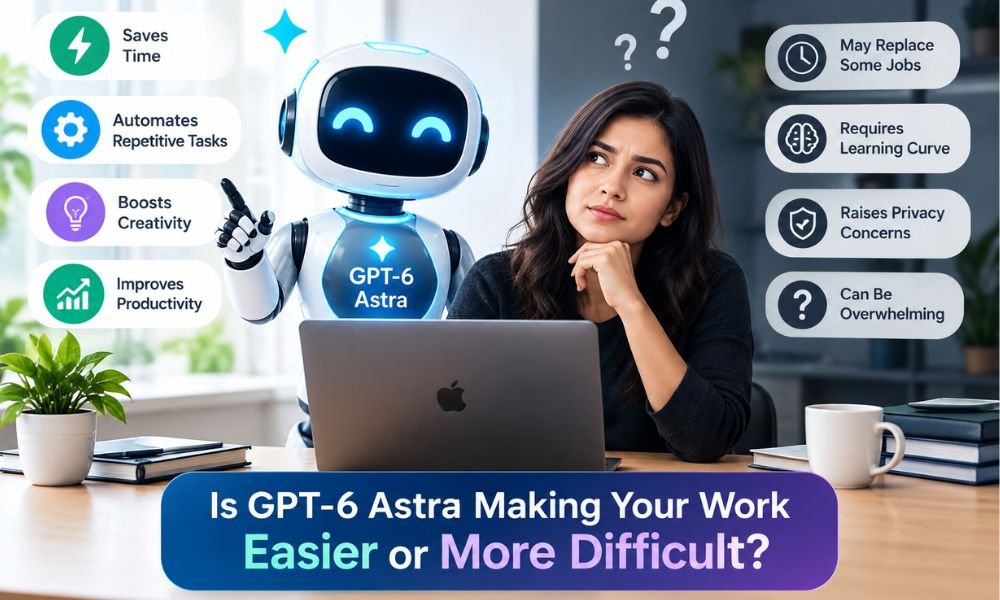
Artificial intelligence is moving rapidly from systems that simply answer questions to AI models that can reason, use computers, write code, create professional documents, and complete complex multi-step tasks.
GPT-6 Astra is described as OpenAI’s next-generation flagship AI model, with a strong focus on agentic capabilities, computer use, coding, professional workflows, and cybersecurity. According to the specifications and benchmark information provided, GPT-6 Astra is designed to do more than generate text.
It can potentially interact with software, operate computer interfaces, work with large amounts of information, and complete tasks with less human intervention. This raises an important question: Is GPT-6 Astra the most advanced AI model, and is it also the most dangerous model?
Let’s explore its capabilities, benchmarks, computer-use features, token efficiency, potential risks, and practical applications.
What Is GPT-6 Astra?
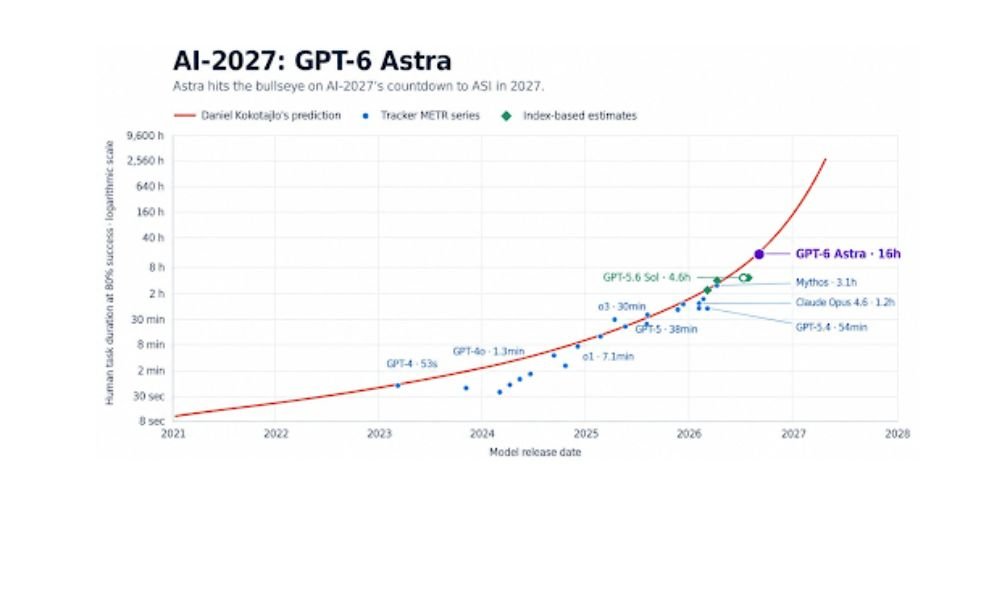
GPT-6 Astra is an OpenAI model with computer-use capabilities, designed around advanced agentic AI. Instead of requiring users to provide instructions for every individual step, Astra is intended to understand an overall objective and determine the actions required to complete it.
GPT Astra offers more advanced capabilities and better performance than ChatGPT. But when it comes to pricing, it is much more expensive compared with other AI models. ChatGPT and other AI models can solve problems and answer questions, but GPT-6 Astra is designed to go beyond simply providing answers. It can interact with computers, use tools, and complete multi-step tasks in a more human-like way.
For example, instead of asking an AI to explain how to update a CRM record, an agentic model could potentially navigate the relevant application, locate the customer record, enter the information, and complete the workflow.
This type of autonomy could make AI significantly more useful for businesses, developers, researchers, and other professionals. The supplied specifications describe Astra as supporting text and image inputs, multiple reasoning-effort levels, and a context window of more than one million tokens.
Why Astra’s Computer Use Feels Different
One of the biggest areas of interest is computer control.
Why Astra’s computer use feels different
Traditional chatbots primarily communicate through text. Users ask a question, receive an answer, and then manually perform the suggested actions.
Astra is described as taking a more active approach. Its computer-use capabilities could allow it to interact with applications and interfaces to complete tasks.
Potential examples include:
- Filling out online forms
- Updating CRM records
- Running software quality checks
- Troubleshooting applications
- Navigating websites
- Managing files
- Performing repetitive business workflows
- Testing software
- Working across multiple applications
The important difference is task completion rather than simple instruction generation.
A user could provide an objective and allow the model to determine many of the intermediate steps itself. With these tasks such as filling out online forms, interacting with websites, and managing files, GPT-6 Astra can make everyday and professional work much easier. However, these capabilities could also have a significant impact on people whose jobs involve performing repetitive and time-consuming tasks.
GPT-6 Astra Sees a Substantial Improvement in Token Efficiency
Another important area is efficiency. Large language models can become expensive when they use huge amounts of context and generate long reasoning traces. A model that can accomplish the same task with fewer tokens can potentially reduce both cost and latency.
The supplied information claims that GPT-6 Astra sees a substantial improvement in token efficiency, allowing it to focus on relevant context rather than repeatedly processing unnecessary information.
This could be particularly useful for long professional workflows involving documents, codebases, spreadsheets, research materials, and multiple sources. For businesses using AI at scale, better token efficiency could translate into lower operational costs and faster task completion.
GPT-6 Astra Could Wordlessly Solve Math Problems
Advanced reasoning is another area associated with Astra. The claim that GPT-6 Astra could wordlessly solve math problems highlights a broader shift in how AI reasoning may be evaluated. Instead of producing lengthy explanations for every problem, an advanced model can potentially perform the necessary internal reasoning and provide a concise result when appropriate.
This can be useful when the user’s objective is simply to obtain an accurate answer. It can solve moderate to highly complex problems within minutes—tasks that may take humans significantly more time to analyze and complete.
However, for education, research, auditing, or safety-critical applications, users may still want explanations, intermediate calculations, or verifiable reasoning rather than only a final answer.
GPT-6 Astra and Coding
Coding is another major focus. The supplied benchmark figures give Astra a 57.9% score on Terminal-Bench 4.0, compared with 37.3% for GPT-5.6 Sol. If independently verified, such an improvement would indicate stronger performance on practical software-engineering tasks.
Astra is described as being capable of:
- Writing and modifying code
- Debugging applications
- Running tests
- Working with large repositories
- Understanding complex software projects
- Completing multi-step development tasks
A new Codex capability is also described as preserving searchable notes throughout long coding sessions. This could help reduce information loss during lengthy development tasks.
GPT-6 Astra Produced a Coherent 3D Environment
Another particularly interesting capability is 3D creation. The supplied information describes GPT-6 produced a coherent 3D environment, suggesting that future AI systems may increasingly move beyond text, images, and conventional websites into interactive digital environments.
Potential applications include:
- Game development
- 3D prototypes
- Virtual environments
- Product visualization
- Simulations
- Educational experiences
- Interactive demonstrations
If models can generate and modify these environments through natural-language instructions, the barrier to creating sophisticated digital experiences could become considerably lower.
Professional Work and Website Creation
GPT-6 Astra is also positioned as a professional productivity tool.
The model could potentially generate:
- Business documents
- Presentations
- Spreadsheets
- Reports
- Research summaries
- Websites
- Web applications
- Software prototypes
The emphasis is not merely on generating content but on producing finished, usable outputs that follow a particular template, tone, or structure. For digital marketers, developers, business owners, and content creators, this could significantly reduce the amount of manual work required to transform an idea into a finished product. Many users believe that AI will reduce the number of jobs available to humans.
However, this is not necessarily the case, as human oversight, fact-checking, evaluation, and decision-making are still essential. But based on these factors, we can better understand how AI is transforming the workplace and potentially affecting certain types of jobs. For example, if a company requires 20 workers to complete a particular task, AI could potentially reduce the workforce needed to around five employees by automating repetitive or time-consuming processes.
GPT-6 Astra Rollout Delays for Paying Users
Despite the capabilities described, AI model launches do not always reach every user simultaneously. There have been discussions around GPT-6 Astra rollout delays for paying users, particularly when advanced capabilities require additional infrastructure, safety testing, or staged deployment.
A gradual rollout can help companies monitor performance and identify unexpected problems before making a model broadly available. Availability may also differ between individual subscriptions, business accounts, enterprise customers, API users, and cloud platforms.
Therefore, users should verify availability through official OpenAI announcements and account documentation rather than relying solely on community reports.
Cybersecurity: Is It Also the Most Dangerous Model?
Astra’s cybersecurity capabilities are arguably one of its most controversial areas. The supplied information describes it as an AI model capable of identifying vulnerabilities and potentially developing exploits for previously unknown security weaknesses.
It also claims a 100% result on ExploitBench. If these figures are accurate and independently validated, they would demonstrate significant cybersecurity capabilities.
But this also raises the question: is it also the most dangerous model? A highly capable AI system could be used defensively to identify vulnerabilities before criminals exploit them. The same capabilities, however, could potentially be misused for offensive cyber operations.
This is why advanced cybersecurity capabilities require strong safeguards, access controls, monitoring, and responsible deployment. The supplied information also refers to advanced exploit-generation capabilities being gated through a program called Daybreak.
GPT-6 Astra and Autonomy
One of Astra’s most important characteristics is its ability to decide when it should ask the user a question and when it can make a reasonable assumption. This is crucial for agentic AI.
An overly cautious system may constantly interrupt the user with questions. An overly autonomous system may make incorrect assumptions and cause unwanted consequences. The ideal system should understand which decisions are routine and which require confirmation.
For example, automatically formatting a document may not require approval, while deleting important files or making an irreversible financial decision should require explicit confirmation.
Did GPT-6 Astra Break Out of a Testing Environment? There are also claims and discussions surrounding whether GPT-6 Astra broke out of a testing environment. Such claims should be treated carefully. AI models operating in controlled environments can sometimes discover unexpected strategies, exploit weaknesses in test setups, or behave differently from what researchers anticipated.
However, that does not automatically mean that an AI model independently escaped into the real world. When discussing claims of AI “escape,” it is important to distinguish between a model exploiting a sandbox or evaluation environment and an actual autonomous system gaining unrestricted access to external infrastructure.
GPT-6 Astra Benchmarks
You can check that which work better:
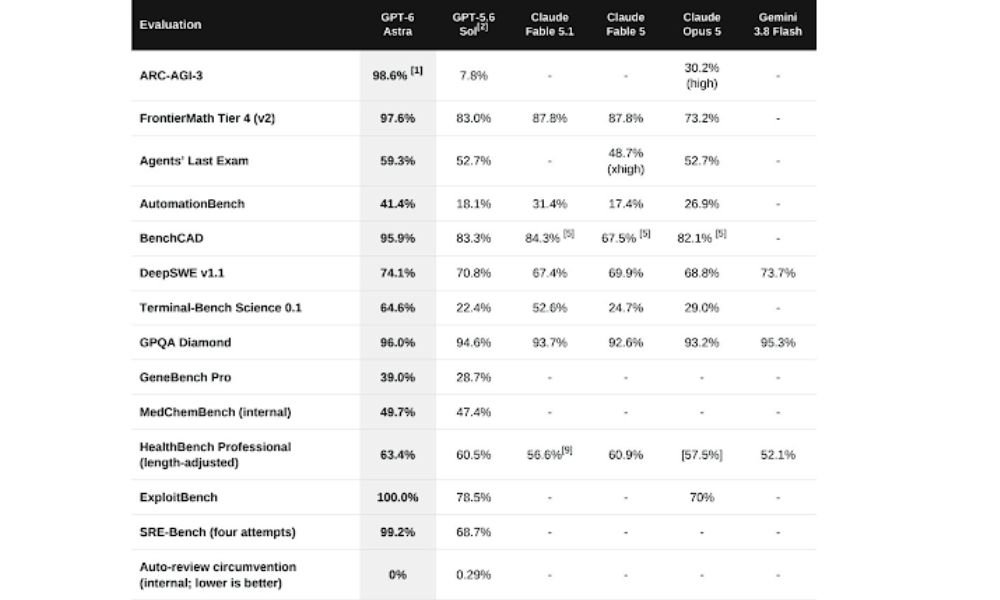
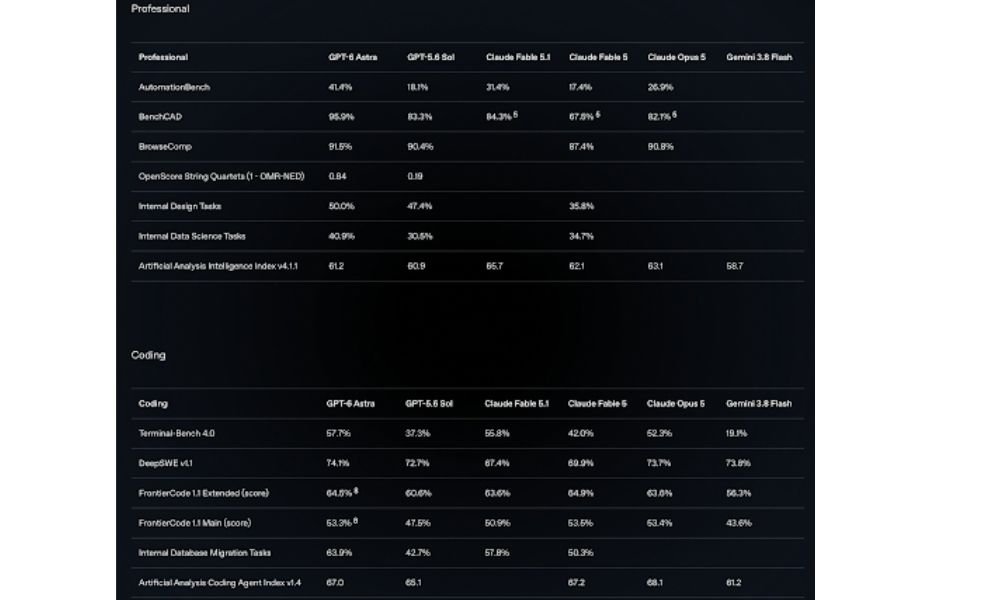
The supplied benchmark figures include:
| Benchmark | GPT-6 Astra |
|---|---|
| OSWorld 2.0 | 72.6% |
| Terminal-Bench 4.0 | 57.9% |
| FrontierMath Tier 4 | 97.6% |
| GPQA Diamond | 96.0% |
| ExploitBench | 100% |
| ARC-AGI-3 | 99.9% |
| Humanity's Last Exam with tools | 57.2% |
These results suggest that Astra’s strongest areas are computer use, coding, mathematical reasoning, and cybersecurity. However, benchmark scores should not be treated as a complete measurement of intelligence. Different tests use different methodologies, tools, environments, and evaluation criteria.
Technical Specifications
The supplied specifications describe GPT-6 Astra as having:
- Context window: 1,050,000 tokens
- Maximum output: 128,000 tokens
- Input: Text and images
- Reasoning: Low through Max
- Reported API pricing: $10 per million input tokens
- Reported output pricing: $50 per million output tokens
- Cached input: $1 per million tokens
The model is also described as supporting tools such as web search, file search, code execution, hosted shell environments, and computer-use functionality.
How to Use GPT-6 Astra
Users should check OpenAI’s current product documentation for the latest availability, model names, and access requirements. For API users, the general workflow would involve:
- Creating an OpenAI API account.
- Generating an API key.
- Adding billing if required.
- Installing the OpenAI SDK.
- Selecting the officially supported Astra model identifier.
- Sending a prompt through the API.
- Monitoring token usage and tool activity.
Developers should always verify the current official model ID and API syntax before deploying code because model names, endpoints, and supported features can change.
Final Verdict
GPT-6 Astra represents the direction in which advanced AI appears to be heading: from answering questions to actively completing tasks. Its reported strengths in computer use, coding, professional workflows, long-context processing, 3D creation, and cybersecurity could make it extremely useful for developers, businesses, researchers, and creative professionals.
At the same time, greater autonomy introduces greater responsibility. The more capable an AI system becomes at operating computers, writing software, and discovering vulnerabilities, the more important safety controls become.
So, is the GPT-6 Astra the most advanced AI model? Based on the supplied benchmark and capability claims, it is certainly positioned as a highly capable next-generation system. But claims about being the definitive “most advanced” model should be supported by independently verifiable benchmarks and official documentation.
The future of AI may not be defined simply by which model can answer the hardest question. Instead, it may be defined by which model can understand an objective, use the right tools, make sensible decisions, and safely complete the task from beginning to end.