
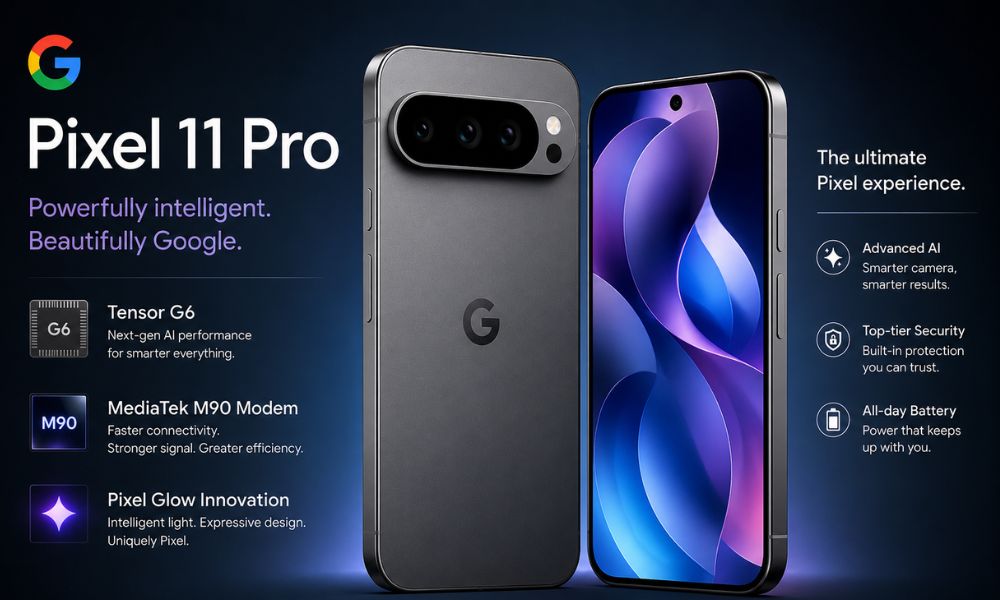
The Google Pixel models are known for having high-quality, smart software and great-looking hardware. In August 2026 at the “Made by Google” event, there will be the release of the new Google Pixel 11 Pro which will make meaningful improvements instead of radical improvements so that they may look and feel different than they used to.
It has a new Tensor processor (chipset), higher quality displays, advanced AI capabilities, and small design refinements. This product won’t make significant changes to smartphones; however, it will improve on what Google already does extremely well—computational photography, enhancing Android functions and providing users with AI capabilities.
Expected Release Date and Pricing
Google is likely to unveil the Pixel 11 lineup—including the Pixel 11 Pro, Pixel 11 Pro XL, and Pixel 11 Pro Fold—in August 2026, following its usual launch cycle. Pre-orders are expected to begin immediately after the announcement, with availability rolling out shortly thereafter.
As for pricing, nothing is officially confirmed yet. However, industry expectations suggest that Google will maintain similar pricing to the previous generation.
The Pixel 11 Pro could start at around $999 for the 128GB variant, with higher storage configurations potentially going up to $1,449. This pricing strategy would keep it competitive with other premium flagship devices while offering strong value through software and AI features.
Performance and Hardware
At the heart of the Pixel 11 Pro is the next-generation Tensor G6 chipset, which is expected to be built on a 2nm manufacturing process. This alone represents a significant leap in efficiency and performance compared to previous Tensor chips.
The rumored CPU configuration includes:
- 1× ARM C1-Ultra core clocked at 4.11 GHz
- 4× ARM C1-Pro cores at 3.38 GHz
- 2× ARM C1-Pro cores at 2.65 GHz
This setup suggests a strong focus on both peak performance and sustained efficiency. The addition of a PowerVR C-Series GPU (CXTP-48-1536) indicates improved graphics performance, which should benefit gaming and high-end visual tasks.
Google is also expected to include the Titan M3 security chip, reinforcing its commitment to device security and privacy. Meanwhile, the inclusion of the MediaTek M90 modem could bring better 5G connectivity, improved signal stability, and enhanced power efficiency.
Alongside this, an upgraded Tensor Processing Unit (TPU) and GXP image processor are likely to deliver faster AI computations and improved image processing capabilities.
Memory and Battery Improvements
The Pixel 11 Pro is expected to offer 12GB or 16GB of RAM, ensuring smooth multitasking and future-proof performance for demanding applications and AI-driven tasks.
Battery capacity is almost same as pixel 10 Pro rumored to be around 4,707 mAh, with marketed capacity potentially reaching close to 4,900 mAh. While the increase may seem modest, improvements in efficiency from the Tensor G6 chip and display technology could result in noticeably better real-world battery life.
One of the most notable upgrades could be 45W wired charging, a step up from previous Pixel models. This would significantly reduce charging times and bring Pixel devices closer to competitors that already offer faster charging solutions.
Display: Brighter, More Efficient, and Smoother
The Pixel 11 Pro Display is expected to be the same as iPhone 17 and iPhone 17 Pro but resolution and Peak brightness differ to feature a 6.3-inch OLED display with a resolution of 1280×2856 and a 120Hz variable refresh rate. Peak brightness could reach up to 2,450 nits, making it easier to use in bright outdoor conditions.
The larger Pixel 11 Pro XL variant may offer the same display as oneplus13, Honor Magic 7 Pro almost aroung 6.8-inch OLED display with a resolution of 1344×2992, maintaining the same smooth refresh rate and brightness capabilities as Pixel 11 Pro.
Both models are rumored to use Samsung’s M16 OLED panels, which are expected to deliver better color accuracy, higher brightness, and improved energy efficiency compared to the previous M14 panels. This means users can expect a more vibrant viewing experience without sacrificing battery life.
Camera System: AI Continues to Shine
Google has built its reputation on smartphone photography, and the Pixel 11 Pro will likely continue that legacy. The expected camera setup includes:
- 50MP main sensor
- 48MP ultra-wide camera (Sony IMX858)
- 48MP telephoto lens with 5x optical zoom
- 42MP front-facing camera
Rather than focusing on major hardware changes, Google appears to be doubling down on AI-powered photography enhancements. This could include better low-light performance, improved HDR processing, enhanced portrait modes, and more advanced computational zoom capabilities.
Earlier rumors of a 10x optical zoom or periscope upgrade have not been strongly supported in recent leaks, suggesting that Google may prioritize software-driven improvements instead.
Design: Familiar Yet Refined
The Pixel 11 Pro is expected to retain the signature Pixel design language, including the iconic camera bar. However, there are some subtle refinements rumored:
- A black camera bar for a more premium and consistent look
- A slightly slimmer and less protruding camera module
- Flat edges for improved grip and modern aesthetics
While these changes may not be dramatic, they reflect Google’s approach of refining rather than reinventing its design.
Pixel Glow: A Unique New Feature
One of the most interesting rumored additions is Pixel Glow, which could replace the temperature sensor found in previous models. This feature is said to include a small RGB LED array integrated into the camera bar.
Pixel Glow could serve as a customizable notification system, allowing users to assign different colors for calls, messages, and app alerts. This adds a visual and personalized touch to the device, setting it apart from competitors.
Battery, Efficiency, and Future Possibilities
Although battery capacity increases appear modest, the combination of a more efficient chipset and improved display technology could deliver better overall endurance.
There are also early speculations about removable battery designs, particularly in relation to future EU regulations. While this feature is more likely for foldable devices, there is a possibility that elements of this approach could influence the Pro lineup in the future.
Additionally, reports suggest that IR-based face unlock may not be ready for this generation, meaning Google could continue relying on its existing biometric solutions.
Final Thoughts
The Google Pixel 11 Pro doesn’t seem to be a revolutionary upgrade—but that’s not necessarily a bad thing. Instead, it focuses on refining the core Pixel experience with:
- A more powerful and efficient Tensor G6 chipset
- Improved display technology with higher brightness and efficiency
- Enhanced AI-driven camera performance
- Faster charging capabilities
- Subtle but thoughtful design updates
For users already invested in the Pixel ecosystem, the Pixel 11 Pro could be a compelling upgrade. For others, it represents a mature and well-rounded flagship that prioritizes intelligence and usability over flashy gimmicks.
As we move closer to its expected launch in August 2026, more details will likely emerge. But based on current information, the Pixel 11 Pro is shaping up to be a device that perfects the Pixel formula rather than redefining it.
FAQ
Is the Pixel 11 Pro good for high-performance gaming?
Yes, the Google Pixel 11 Pro is expected to deliver strong gaming performance with the Tensor G6 chipset, Vulkan 1.4 support, improved thermal management, and AI-powered optimization. It should handle high-frame-rate gaming smoothly, although gaming-focused phones may still offer better sustained cooling performance.
Is the Pixel 11 Pro fully waterproof?
No, the Pixel 11 Pro is not expected to be fully waterproof. According to leaks and industry expectations, it may come with an IP68 rating, which provides resistance against dust and water splashes or brief submersion, but it is not designed for deep-water or long-duration underwater use.
Is the Pixel 11 Pro battery size less than the Pixel 10 Pro?
According to Mystick leaks, the Pixel 11 Pro may feature a slightly smaller battery capacity compared to the Pixel 10 Pro. However, Google is expected to improve battery efficiency through the Tensor G6 chipset and Android optimization for better overall battery life.
Is it worth buying the Pixel 11 series?
The Google Pixel 11 series could be worth buying for users who want advanced AI features, a clean Android experience, powerful cameras, Pixel Glow functionality, and long-term software updates. It may especially appeal to users interested in Google’s latest AI ecosystem and exclusive Pixel features.