
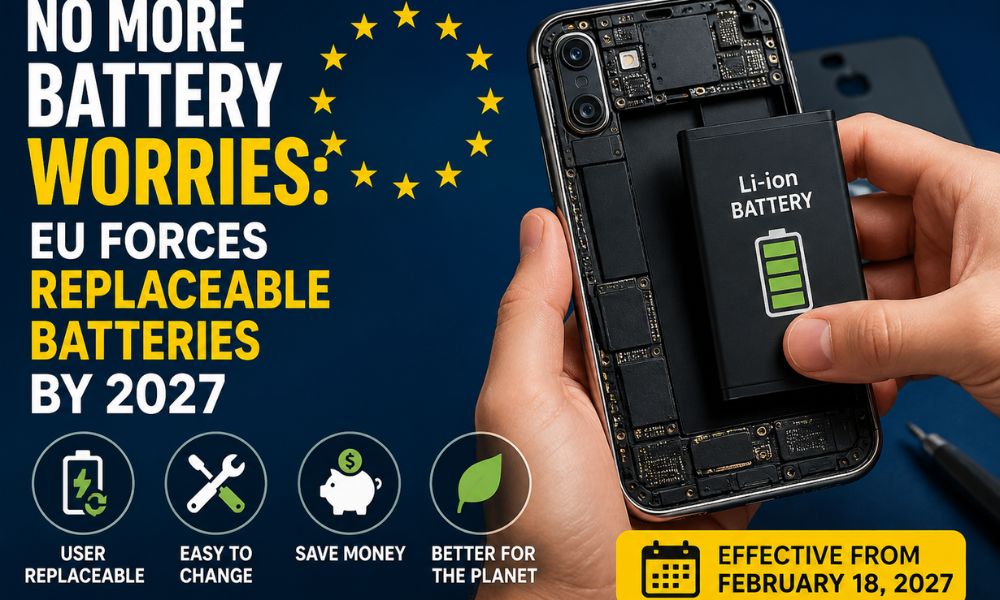
The days of sealed smartphones may finally be numbered—at least in Europe. Starting February 18, 2027, the European Union will enforce a major regulation requiring all new smartphones and tablets sold in its market to feature user-replaceable batteries.
This move is already generating strong reactions from consumers, manufacturers, and environmental advocates alike, and for good reason: it directly addresses one of the most persistent frustrations in modern devices—battery degradation.
A Return to the Past, with Modern Expectations
Before the 2000s, removable batteries were standard. If your phone battery wore out, you simply swapped it with a new one in seconds. As smartphones evolved, however, manufacturers shifted to sealed designs. These allowed for slimmer profiles, better water resistance, and more rigid builds—but at the cost of repairability.
Today, most high-demand smartphones, from premium models like the iPhone 18 to budget-focused devices like the Tecno Pova Curve, come with non-replaceable batteries. Once the battery health drops, users are forced to either visit service centers, pay high repair costs, or replace the entire device. This is exactly the cycle the EU wants to break.
What the 2027 EU Battery Rule Means
The new regulation is not just about making batteries removable—it sets clear, practical standards that manufacturers must follow:
1. Mandatory Replaceability
Devices must allow users to remove and replace batteries using common, widely available tools. This means no excessive glue, no heat guns, and no complicated disassembly processes. Adhesives that require solvents or high temperatures will largely be restricted.
2. Long-Term Spare Parts Availability
Manufacturers will be required to provide replacement batteries for at least 5 to 7 years after a device is discontinued. These batteries must be reasonably priced, ensuring users are not discouraged by inflated costs. If a special tool is necessary, brands must provide it free of charge.
3. Battery Durability Standards
The regulation also focuses on quality. Batteries must retain at least 80% of their original capacity after 800 to 1,000 charge cycles. This ensures users get reliable performance over time, not just easy replacement.
4. Sustainable Design Approach
Even with removable batteries, manufacturers are expected to maintain modern features like water and dust resistance. This may lead to innovative designs using modular components, standardized screws, and reduced reliance on adhesives.
Why This Matters for Consumers
For users, the benefits are immediate and practical. Battery degradation is one of the main reasons people replace their phones. With replaceable batteries, a device that would otherwise become sluggish or unreliable can get a second life in minutes.
It also reduces dependency on service centers. Instead of waiting days for a repair or paying high service fees, users can handle battery replacement themselves. This shift puts more control back in the hands of consumers.
There’s also a financial advantage. Replacing a battery is significantly cheaper than buying a new smartphone. Over time, this could change purchasing behavior, encouraging users to hold onto devices longer.
Environmental Impact: A Bigger Win
Beyond convenience, the environmental implications are substantial. Electronic waste is a growing global problem, and smartphones contribute heavily due to their short replacement cycles.
By extending device lifespan, the EU regulation aims to reduce e-waste significantly. Fewer discarded phones mean less strain on recycling systems and lower demand for raw materials like lithium, cobalt, and rare earth metals.
Longer-lasting devices may also encourage manufacturers to provide extended software support. After all, a phone that can physically last longer should remain usable from a software perspective too.
Challenges for Manufacturers
This transition won’t be easy for smartphone makers. Sealed designs have dominated the industry for years, and shifting back to replaceable batteries requires rethinking internal architecture.
Brands will need to balance durability, aesthetics, and repairability. Waterproofing, in particular, is a challenge—but not an impossible one. Advances in engineering could lead to new design standards that maintain IP ratings without relying heavily on glue.
There’s also the question of design consistency. While the law applies to the EU, global brands may choose to standardize their products worldwide rather than create separate models for different regions.
Are There Any Exceptions?
Yes, the regulation does allow for some flexibility. Devices used in specialized fields—such as medical equipment or certain industrial smartphones—may be exempt if removable batteries compromise safety or performance.
Additionally, manufacturers can explore alternative compliance pathways if they can demonstrate exceptional battery longevity combined with durability. However, these exceptions are expected to be limited.
A Global Ripple Effect
Even though this rule is EU-specific, its influence will likely extend far beyond Europe. Similar to how EU regulations pushed widespread adoption of USB-C charging ports, this battery mandate could reshape global smartphone design standards.
If major brands redesign their devices for compliance, it makes little sense to maintain different designs for other markets. As a result, consumers worldwide—including in countries like India—may benefit from more repairable smartphones.
Final Thoughts
The EU’s 2027 battery regulation is more than just a technical requirement—it’s a shift in philosophy. It challenges the disposable nature of modern electronics and promotes longevity, sustainability, and consumer empowerment.
While there may be trade-offs in design or thickness, the overall impact leans strongly in favor of users. Being able to replace your smartphone battery in seconds—without tools, without waiting, and without high costs—brings back a level of practicality that many users have been missing.
If implemented effectively, this regulation could mark the beginning of a new era in smartphone design—one where performance, sustainability, and user control go hand in hand.