
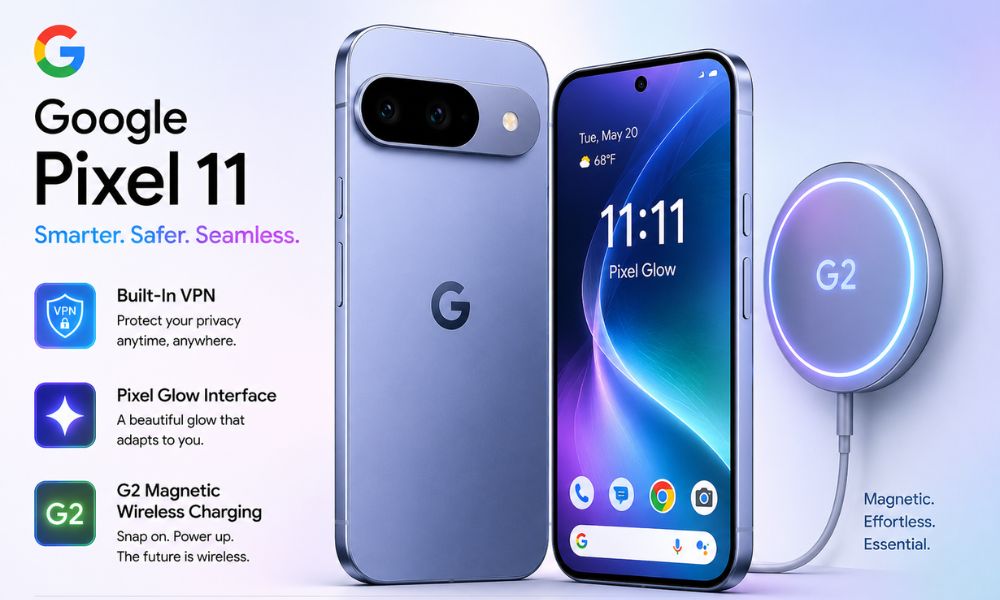
Google plans to release the Pixel 11 Pro in August 2026. Although there may not be much excitement over the changes made to this iteration since the designs are relatively subtle, there is much more than what meets the eye.
It seems that instead of redesigning their smartphones, Google has concentrated its efforts on developing the camera and artificial intelligence aspects as well as improving the overall performance of the device.
According to reports based on CAD renders and leaks, the new iteration will be one of the best smartphones produced by Google, especially for people interested in taking pictures and software intelligence.
The Pixel Glow functionality will be useful in allowing users to communicate interactively through notifications, the Gemini Live functionality, and visual responses. Users can expect many different types of animations, such as breathing, flashing, and color looping effects.
Refined Design with a Subtle but Smart Camera Bar Update
At the design level, Google is continuing its signature camera bar approach, but with noticeable refinements. The camera bar now appears fully blacked out, giving it a cleaner and more unified look compared to previous Pixel models.
One interesting addition is the integration of hidden LED lighting beneath the camera bar, which could serve both functional and aesthetic purposes. While Google hasn’t officially confirmed its exact use, it may play a role in notifications, camera assistance, or the new “Pixel Glow” feature.
That said, if you’re expecting a dramatic redesign, you might be disappointed. Google has clearly chosen evolution over experimentation, focusing on polishing what already works.
Android 17 and a Stronger Focus on AI
The Pixel 11 Pro will ship with Android 17 beta 4 code, bringing tighter system optimization and deeper AI integration. Google continues to push the idea that Pixel devices are not just smartphones, but AI-driven personal assistants. The Pixel 11 is currently the only device to ship with the Android 17 Beta 4 build, underscoring its early access to the latest software innovations.
A standout mention here is the Pixel Glow system, which replaces older hardware elements like temperature sensors with something more useful and space-efficient. This reflects Google’s strategy: prioritize features that enhance real-world usability rather than niche hardware.
In today’s digital era, smartphones without AI capabilities can feel limited and less engaging. AI plays a central role across the system—from camera processing to battery optimization and security. In fact, this may be the most AI-dependent Pixel yet.
Difference between Pixel 11, Pixel 11 pro and Pixel 11 pro XL
| Feature | Pixel 11 | Pixel 11 Pro | Pixel 11 XL |
|---|---|---|---|
| Display | 6.3" Dynamic AMOLED | 6.4" Dynamic AMOLED | 6.9" Dynamic AMOLED |
| Resolution & Refresh Rate | 2424 × 1080, 120Hz | 2868 × 1344, 120Hz | 2992 × 1344, 120Hz |
| Selfie Camera | 12MP | 42MP | 42MP |
| Rear Camera | Triple Camera Setup | Triple Camera Setup | Triple Camera Setup |
| Processor | Tensor G6 | Tensor G6 | Tensor G6 |
| RAM & Storage | 12GB RAM, 128/256GB | Up to 16GB RAM, up to 1TB | Up to 16GB RAM, up to 1TB |
| Battery | 5000 mAh | 5100 mAh | 5400 mAh |
| Connectivity | 5G, Bluetooth 6, Wi-Fi 7, NFC | 5G, Bluetooth 6, Wi-Fi 7, UWB | 5G, Bluetooth 6, Wi-Fi 7, UWB |
| Operating System | Android 17 | Android 17 | Android 17 |
| Price | $799 | $999 | $1199 |
Tensor G6: Performance Meets Efficiency
At the heart of the Pixel 11 Pro is the Tensor G6 chipset, designed to deliver improved performance while maintaining efficiency. Reports suggest higher clock speeds and better power management, making the device more responsive in everyday tasks.
There have been rumors about a “CXTP 481536 GPU,” but these claims appear to be inaccurate. Instead, the device supports Vulkan 1.4, ensuring better graphics rendering and compatibility with modern applications and games.
Rather than chasing raw benchmark numbers, Google continues to optimize for real-world performance, particularly in AI workloads and camera processing.
Camera System: Smarter, Not Just Better
Google has always prioritized camera performance, and the Pixel 11 Pro is no exception. This year, the focus shifts toward advanced computational photography and video capabilities.
One of the key highlights is ultra low-light video recording, which could significantly improve nighttime videography—a long-standing weakness in many smartphones.
Google is also enhancing its imaging pipeline by combining optical data with AI reconstruction. This means the camera doesn’t just capture light—it intelligently rebuilds scenes for better clarity, detail, and color accuracy.
In simple terms, the Pixel 11 Pro isn’t just taking photos—it’s interpreting them.
Improved Battery Design
There has been a lot of buzz around removable batteries, especially with upcoming global regulations. However, the Pixel 11 Pro does not feature a fully user-removable battery.
Instead, it introduces a non-adhesive battery design that slides into place, making repairs and replacements significantly easier. While you won’t be swapping batteries on the go, this is still a step forward for repairability and longevity.
It’s a practical middle ground between sealed designs and fully removable batteries.
Built-In VPN and Advanced Security
Security is another area where the Pixel 11 Pro stands out. The device includes a built-in VPN feature with threat protection, helping users stay safe online without needing third-party apps.
Even more impressive, one subscription can cover up to 10 devices, making it a valuable addition for families or users with multiple gadgets.
This reflects Google’s growing emphasis on privacy and security as core features, not optional extras.
Magnetic Wireless Charging Support
Wireless charging support is already available on most flagship smartphones, including the iPhone 17 series, iPhone 17e, Google Pixel 10a, and Samsung Galaxy S25/S26 series. The Pixel 11 Pro is also expected to support G2 magnetic wireless charging, aligning with industry trends toward more convenient and efficient charging solutions.
This could open the door to a broader ecosystem of magnetic accessories, including chargers, mounts, and cases.
Pixel Glow: A Meaningful Addition
One of the more intriguing features is Pixel Glow, which appears to replace older hardware like temperature sensors. While details are still limited, it seems to be a smarter use of internal space with added functionality.
Unlike gimmicky features, Pixel Glow feels like something designed to enhance user interaction, rather than just exist for marketing purposes.
Not a Radical Redesign—And That’s Okay
It’s important to set expectations: the Pixel 11 Pro is not a massive design overhaul. If you’re looking for a completely new look, this might feel underwhelming.
But that’s not the goal here.
Google is focusing on what actually matters:
- Better camera performance
- Smarter AI features
- Improved efficiency
- Enhanced security
- Easier repairability
These are the upgrades that impact everyday usage, not just spec sheets.
Should You Upgrade?
If you’re using an older Pixel device (Pixel 8 or earlier), the Pixel 11 Pro could be a significant upgrade, especially in camera and AI performance.
However, if you already own a recent Pixel, the decision becomes more nuanced. The improvements are meaningful—but not revolutionary.
Final Thoughts
The Google Pixel 11 Pro, expected in August 2026, focuses on meaningful upgrades rather than major design changes. It features a refined blacked-out camera bar with hidden LED elements and runs on Android 17, emphasizing deeper AI integration. Powered by the Tensor G6 chipset, it delivers improved performance, efficiency, and Vulkan 1.4 support.
Camera innovation remains the highlight, with ultra low-light video capabilities and advanced imaging that combines optical data with AI reconstruction for better results. The device introduces a non-adhesive battery design, making repairs easier, though it is not fully removable.
Security is enhanced with a built-in VPN and threat protection, supporting up to 10 devices. It also includes G2 magnetic wireless charging and the new Pixel Glow feature, replacing older hardware elements.
Overall, the Pixel 11 Pro prioritizes AI, camera performance, and everyday usability, making it a strong upgrade for users seeking smarter smartphone experiences.
FAQ
Is the Google Pixel 11 series better than the iPhone 17?
The Google Pixel 11 series offers a clean Android experience, advanced AI-powered features, Pixel Glow integration, and exclusive Google software enhancements. Meanwhile, the iPhone 17 series focuses on Apple’s ecosystem, optimized performance, and long-term software support. The better choice depends on whether users prefer Android flexibility with AI features or Apple’s seamless ecosystem experience.
Does the Google Pixel 11 series Tensor G6 work really better than Geekbench scores suggest?
Yes, the Tensor G6 chipset is expected to deliver better real-world performance than benchmark numbers alone indicate. Google optimizes Tensor chips for AI processing, photography, voice recognition, and daily multitasking rather than focusing only on synthetic benchmark scores like Geekbench.
Is the Google Pixel 11 series Pixel Glow really a unique concept?
Yes, Pixel Glow is considered a unique feature because it combines visual notification effects, AI interactions, and customizable animations into a dedicated lighting experience. It enhances user interaction with alerts, Gemini AI features, and system activities in a more dynamic way.
Does the Google Pixel 11 series Pixel VPN protect against every threat?
No, Pixel VPN improves online privacy and encrypts internet traffic, but it cannot guarantee protection from every cyber threat. Users should still follow safe browsing practices, avoid suspicious downloads, and keep their devices updated for better security.
Does the Google Pixel 11 series Vulkan 1.4 deliver better gaming performance?
Yes, Vulkan 1.4 is expected to improve gaming performance on the Google Pixel 11 series by offering better graphics optimization, smoother frame rates, lower latency, and improved power efficiency for supported games and applications.