
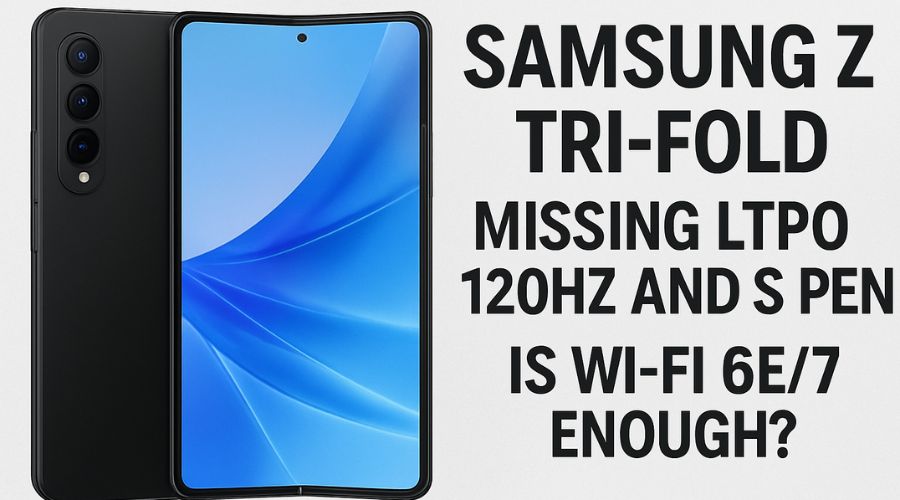
Samsung’s folding technology continues to evolve, and the upcoming Samsung Z TriFold is one of the most highly anticipated innovations in the smartphone industry. Boasting a three-way folding design, ultra-portable form factor, and productivity-first layout, this tri-fold device may change what you know about a hybrid smartphone-tablet.
But according to leaks and early reports, the Samsung tri fold may include some unexpected compromises, too: the lack of LTPO 120Hz, missing S Pen support, and a scaled-down camera system have already raised concerns among Samsung fans. At the same time, it will introduce next-gen connectivity like Wi-Fi 6E/7, making it a future-proof powerhouse.
So, the big question is:
Is the next-gen Wi-Fi 6E/7 connectivity enough to compensate for the missing premium features?
This in-depth blog covers everything from design philosophy to specs, performance expectations, and real-world usability for the Samsung Galaxy Tri Fold.
A New Form of Foldable Innovation
The Samsung Galaxy tri fold represents Samsung’s ambition to deliver a flexible display that folds twice, offering three functional states:
- Compact smartphone mode
- Dual-screen multitasking mode
- Full tablet mode
Engineers will have to develop new hinge systems and different display layers with balanced internal structures to achieve this concept of pushing forward; however, because of all of the complexity related to this concept, it may also result in the omission or limited feature functionalities in this product.
Missing LTPO 120Hz Display: A Surprising Downgrade
The lack of LTPO 120Hz technology on every panel is perhaps the greatest disappointment. LTPO (Low-Temperature Polycrystalline Oxide) provides dynamic refresh rates, which benefit both battery life and smoothness of the display. Samsung currently uses LTPO for all premium device models in their Galaxy S and Z Fold ranges.
However, on the Samsung Z TriFold, early reports suggest:
- Possible use of 120Hz only on the main unfolded panel
- 60Hz to 90Hz on secondary or outer panels
- No adaptive LTPO technology, likely due to structural constraints
Why this compromise?
Since the tri-fold device uses a complex flexible assembly and multiple parts for the hinge supports, Samsung likely chose a more stable form of display technology versus an advanced but breakable LTPO matrix. As such, for those who expect ultra-smooth scrolling on their tri-fold (especially in compact phone mode), this would create limitations.
No S Pen Support: A Major Creative & Productivity Limitation
The lack of S Pen compatibility is another surprising omission.
Given the large unfolded tablet-like screen, S Pen support would have made the device ideal for:
- Note-taking
- Drawing
- Multitasking productivity
- Pro-level content creation
But adding S Pen support to a three-way folding panel is significantly more challenging than on a two-way fold like the Z Fold lineup.
Reasons behind the missing S Pen:
- The tri-fold display uses more flexible layers, which can’t handle pen pressure.
- Adding Wacom digitizer functionality may increase thickness and cost.
- Reinforcing the center fold area to support pen input could affect durability.
While the decision makes sense from an engineering perspective, it still feels like a missed opportunity for users who want a professional-grade productivity device.
Scaled-Down Camera System: Not a Photography Flagship
Samsung’s Ultra series has set high expectations with its 200MP sensors and advanced zoom capabilities. However, the Samsung Galaxy tri fold may not feature a top-tier camera system. Instead, it may include:
- Mid-to-upper mid-range sensors
- Moderate zoom capabilities
- Standard ultrawide and primary lenses
- Smaller aperture sizes due to space constraints
Why not include flagship cameras?
- Space limitations in the tri-fold design
- High-end sensors increase heat generation
- Samsung focusing on portability over camera hardware
Still, Samsung is expected to compensate using software processing and AI enhancements.
But Here’s the Big Gain: Wi-Fi 6E and Wi-Fi 7
While Samsung cuts down some premium hardware features, it upgrades the connectivity significantly.
The Samsung Z TriFold is expected to support:
- Wi-Fi 6E (6GHz band)
- Wi-Fi 7, the next-gen connectivity standard
What does this mean for users?
1. Much faster wireless speeds
Perfect for cloud gaming, 8K streaming, and massive downloads.
2. Lower latency
A massive advantage for remote work, video calls, and gaming.
3. Improved bandwidth and stability
Ideal for users who often multitask on multiple screens in tri-fold mode.
4. Future-proofing
As routers shift toward Wi-Fi 7, the TriFold will stay ahead for years.
This makes Wi-Fi 6E/7 one of the strongest selling points of the device.
Performance Expectations
Although Samsung hasn’t confirmed the chipset, the Samsung Z TriFold will likely feature a flagship-grade processor such as:
- Snapdragon 8 Gen 4
- or
- An advanced Exynos variant
The chipset will handle:
- Multi-window multitasking
- AI-powered workflows
- Large-screen animations
- Seamless transitions between fold modes
RAM options may start from 12GB, with storage from 256GB to 1TB.
Samsung Galaxy Tri Fold Specs
The Samsung Galaxy tri fold is expected to include a triple-fold AMOLED display, high processing power, next-gen connectivity (Wi-Fi 6E/7, 5G), 12GB+ RAM, optimized software for triple-screen multitasking, and premium build quality. However, it may miss LTPO 120Hz across all panels, S Pen input, and top-tier flagship cameras.
Is Wi-Fi 6E/7 Enough to Compensate?
Whether the next-gen connectivity compensates for missing features depends on the user:
1. For Productivity Users
Yes – connectivity and multitasking are more crucial than camera hardware and LTPO displays.
Professionals relying on cloud apps, remote desktop tools, large file transfers, and video conferencing will benefit greatly from Wi-Fi 6E/7. These standards offer faster speeds, lower latency, and more stable connections even in crowded networks. Combined with Samsung’s multi-window features and a large foldable screen, the TriFold becomes a powerful productivity device-even without LTPO or S Pen support. For such users, network reliability and multitasking efficiency trump display refresh-rate benefits.
2. For Artists and Note-Takers
No — The missing S Pen is still a major drawback.
That gap in your workflow-whether it be drawing, sketching, digitally illustrating, taking handwritten notes, or getting precise stylus input-is not helped one bit by Wi-Fi speed. The S Pen has been a mainstay for creative users on both Fold and Note devices, providing pressure sensitivity and palm rejection, along with accurate control.
Take away S Pen support, and the TriFold becomes much less interesting for creators, students, and professionals reliant on stylus-based productivity.
3. For Multimedia Lovers
Partially — the faster Wi-Fi helps streaming, while LTPO 120Hz would have been ideal for visuals.
For 4K movie streaming, cloud gaming, and high-bitrate content, Wi-Fi 6E/7 will bring definite advantages. It enables smoother playback with reduced buffering, faster downloads, and more reliable network performance.
But for those who value visual quality, motion smoothness, and energy efficiency, the missing LTPO 120Hz adaptive refresh rate is palpable. LTPO saves battery and delivers a silky experience while scrolling, gaming, or navigating.
So, while connectivity helps, it doesn’t fully replace what LTPO brings to multimedia users.
4. For Tech Enthusiasts & Early Adopters
Yes, the futuristic design and form factor might outweigh these compromises.
Tech-savvy users often appreciate innovation, design breakthroughs, and evolutions of a product’s form factor more than minor feature gaps. The Z TriFold brings into play another generation of foldables with a never-before-seen tri-folding mechanism, expanded screen estate, and connectivity fit for the future.
These users generally care more about trying new technology, experimenting with capabilities, and exploring cutting-edge form factors. For them, the missing LTPO or S Pen may feel secondary compared to owning one of the most advanced foldable devices available.
Final Thoughts
The Samsung Z TriFold is shaping up as one of the most futuristic foldables ever made. It may not deliver on every premium feature you might expect, such as LTPO 120Hz everywhere, S Pen support, or top-tier camera sensors, but it still stands out thanks to its groundbreaking design and future-ready Wi-Fi 6E/7 connectivity.
Clearly, Samsung is betting more on innovative and practical value rather than the stacking of every flagship feature. Whether this balance is the right one will depend on user expectations once this device launches.
FAQ
1. Does the Samsung Z TriFold support LTPO 120Hz like other flagship foldables?
No, the Samsung Z TriFold does not sport LTPO 120Hz; you lack the efficiency of adaptive refresh rate and smoother responsiveness compared to LTPO-carrying flagship devices.
2. Why did Samsung skip S-Pen support on the Z TriFold?
Samsung likely removed S Pen support for the device’s ultra-thin folding display, structural limitations, and durability concerns. Adding a digitizer layer could raise everything from weight to screen damage risks.
3. Are Wi-Fi 6E and Wi-Fi 7 features good enough to make up for missing hardware upgrades?
For most users, the major benefits with Wi-Fi 6E and 7 are higher speeds, lower latency, and better network stability; these are great improvements for productivity and cloud use, but they don’t replace the value of an LTPO display or S Pen for creators and power users.
4. How is the display experience of the Z TriFold compared with other trifold or foldable devices?
The main display is still sharp, bright, and immersive, but without LTPO 120Hz, it falls behind the rivals such as Huawei Mate X series and even Samsung’s own Z Fold lineup in terms of adaptive smoothness and power efficiency.
5. Is the Samsung Z TriFold still worth buying sans S Pen and LTPO 120Hz?
Yes-If your priority is multitasking, portability, and the fastest wireless connectivity Wi-Fi 6E/7. However, if you need the best display tech and stylus productivity, the lack of those features might be a deal-breaker.