
Apple’s latest iOS 27.2 RC update introduces several refinements for compatible iPhones, including expanded Siri AI language support, Group FaceTime Dual Capture, Apple TV app profiles, and a redesigned Apple Music icon. Rather than delivering a complete redesign of iOS, this release focuses on improving the user experience through additional features, interface changes, and system-level refinements.
The release candidate also provides developers with an opportunity to test their apps against the upcoming software version before its public rollout. However, some features introduced during early beta testing, including a redesigned Health app, reportedly did not make it into the RC build. You need at least 20 GB of free storage to install the update.
This update is currently available only to beta users. If you are not a beta user, you will need to wait for the stable release. This update supports the iPhone 11 and all newer iPhone models. This update is also available for Apple Watch, iPads, and Macs.
So, what does the iOS 27.2 RC update offer, and should you install it before the stable release? Here is everything you need to know about its features, potential bugs, performance, and compatibility.
iOS 27.2 Is Out in Release Candidate: What’s New?
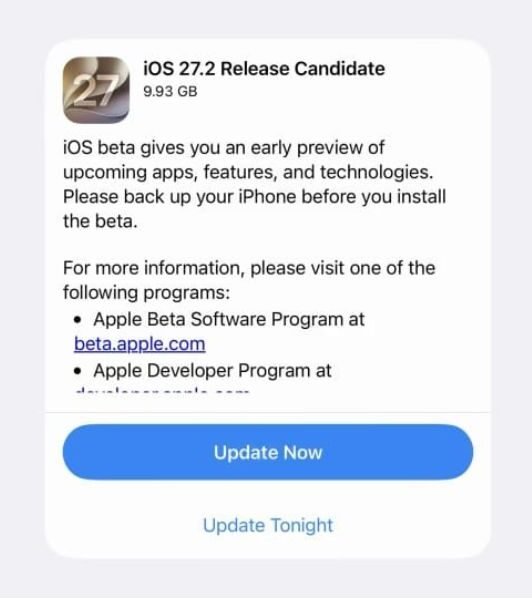
The release candidate is an important stage in Apple’s software development process. It generally indicates that a software update is close to its final version, provided no significant problems require another build.
According to the supplied release information, iOS 27.2 RC is built 24B115. Apple has also released a special build of iOS 27.2 RC, so developers and users should verify the build number and device compatibility before installing it.
The update focuses on Siri’s expanded language support, FaceTime improvements, Apple TV profiles, and Apple Music interface changes. It also includes smaller refinements across the operating system.
Key Features of the iOS 27.2 RC Update
Siri Expands AI Language Support
Before the iOS 27.2 update, these languages were not supported by Siri but one of the notable changes is that iOS 27.2 RC expands Siri AI language support. The supplied reports identify five additional languages:
- French
- Japanese
- Korean
- Portuguese
- Spanish
Additional localization changes and subtle interface refinements are also reported. Expanded language support could make Siri more useful to people who prefer interacting with Apple’s assistant in their primary language.
However, language availability does not automatically mean every AI feature works identically in every region. Supported languages, device compatibility, and regional restrictions may vary. In EU Countries or mainland China, Siri AI features are reportedly unavailable on iPhones, iPads, and Apple Watch due to regulatory requirements under the EU’s Digital Markets Act (DMA). However, these features may be available on macOS, depending on the specific feature and region.
Apple is also working to expand language support for Siri AI. The languages on its existing or planned support list include Chinese (Simplified), Chinese (Traditional), Danish, Dutch, English, French, German, Italian, Japanese, Korean, Norwegian, Portuguese, Spanish, Swedish, Turkish, and Vietnamese. Users may see support for additional languages roll out in the coming days or through future software updates.
Users should check Apple’s official documentation to confirm which Siri and Apple Intelligence features are available for their devices and preferred languages. Siri AI usage may have certain limits. If you reach the usage limit, access to Siri AI features may be temporarily paused until the limit resets.
Group FaceTime Dual Capture
Group FaceTime Dual Capture is another reported addition that carries over from the beta testing period into the release candidate. Dual Capture is designed to offer a more flexible video-calling experience. Depending on the final implementation and supported devices, it could be useful for people who want to capture or share multiple visual perspectives during a call.
For users who frequently make group video calls, this feature may improve the way they communicate and share content. However, its exact capabilities, device requirements, and availability should be confirmed against Apple’s official release notes before making a definitive feature claim.
This means you no longer need to switch to a separate video-calling app to communicate with someone. In iOS 27.2, FaceTime allows you to bring a professional human interpreter or a third-party captioning service directly into your FaceTime call. This feature allows you to make voice and video calls using a single platform, without switching between different apps.
To use this feature, you need to install a supported Video Relay Service (VRS) app. You can then add the interpreter to your FaceTime call as a separate participant tile. This is not an automatic translation. Instead, FaceTime provides a way for a professional human interpreter to join the same call and translate the conversation in real time.
How to use this feature:
- Apple has added a Sign Language button inside the three-dot menu in FaceTime.
- Select the Sign Language option.
- Choose an installed VRS app, and FaceTime will add it to your call.
- The interpreter initially appears in a separate tile with the message “Waiting for Interpreter.”
- Once connected, the interpreter’s name appears, and they can interpret the conversation live for everyone on the call.
Important clarification: Installing a VRS app is not mandatory for everyone. You only need to install one if you want to use this interpreter service.
Apple TV App Profiles
The Apple TV app reportedly gains profile support in iOS 27.2 RC. Profiles can help provide a more personalized viewing experience, particularly for households where multiple people use the same service or device. Apple TV allows you to share your subscription with family members through Family Sharing, so everyone can enjoy their own personalized viewing experience with separate recommendations and watch histories.
Separate profiles may make it easier to distinguish individual preferences and viewing activity. The precise profile-management options available on iPhone should be verified once the final version and documentation are available.
This change could be especially useful for users who regularly watch movies and television shows through Apple’s entertainment ecosystem.
Apple Music Gets a Visual Refresh
Apple Music is also reported to receive a visual update. The supplied information describes a monochrome black-and-white app icon replacing the previous red design, alongside a blue highlight color for the active tab. Favored and pinned playlists are now highlighted with a yellow or golden star, replacing the previous red marker.
Although these changes are primarily visual, they contribute to the overall appearance of the operating system. The updated icon and tab styling may also make the app feel more consistent with the broader interface direction.
However, users should not expect a completely new music-streaming experience from these changes alone. The reported updates focus more on appearance than on major changes to music playback or subscription features.
Apple Podcasts and Interface Refinements
“The Home tab features two separate sections: New Episodes and Continue Playing, making it easier to explore content. Apple Podcasts also allows users to search for podcasts using names, titles, or keywords without scrolling through the entire list.
The update reportedly includes Apple Podcasts improvements, such as episode grouping and queue adjustments. These changes may make it easier to organize listening sessions and navigate episodes.
Other reported refinements include smaller interface adjustments across apps and system components. Although individual changes may appear minor, they can improve everyday usability when combined. Nevertheless, claims about faster installation or improved battery performance should be evaluated through testing on supported devices rather than assumed to be guaranteed benefits.
What Happened to the Redesigned Health App?
One notable detail concerns the redesigned Health app that reportedly appeared during early iOS 27.2 beta testing. Neither major nor minor updates have brought any noticeable improvements to the Health app.
According to the supplied reports, the redesigned version was removed before the release candidate, reportedly during beta 4. Therefore, users should not expect that redesign to be included in the iOS 27.2 RC build. Users can order lab tests directly through Apple’s native Health app, but this feature is currently available only in the United States. There is speculation that the feature could return in a later update, such as iOS 27.3. However, without an official confirmation from Apple, its return date remains uncertain.
This is an important reminder that beta features are not guaranteed to appear in the final public release. Apple can change, postpone, or remove features during testing if they need additional development or refinement.
iOS 27.2 RC Changes and Bugs: What Should You Know?
Bugs and errors are among the main concerns with any software update, as they can cause unexpected problems or disrupt important tasks and data. If you rely on your iPhone for important information, it is better to wait for the stable iOS 27.2 release rather than install the beta version.
Beta updates are similar to test versions, so you may experience unexpected bugs, errors, app crashes, or performance issues. Therefore, install beta software at your own risk.
Even after the stable update becomes available, it is worth checking user feedback and reports of potential issues before installing it. Waiting a few days after the official release can help you avoid problems caused by early software bugs.
The main question is whether the iOS 27.2 RC update delivers reliable performance across supported iPhone models. Reports of enhanced performance and improved battery life should be treated cautiously until broader testing confirms the results.
Here are the main areas users should monitor:
| Area | What to check |
|---|---|
| Battery life | Monitor battery consumption during the first few days |
| Device temperature | Check whether the iPhone becomes unusually warm during ordinary use |
| App compatibility | Confirm that essential apps open and work correctly |
| FaceTime | Test group calls and any available Dual Capture functionality |
| Siri | Check language availability and the response to supported requests |
| Apple Music | Verify that the updated interface works as expected |
| Installation | Ensure sufficient storage and a stable internet connection |
Temporary battery drain or increased device temperature can occur after major software installations while background tasks complete. However, these symptoms should not automatically be attributed to iOS 27.2 RC without further investigation.
If you depend on your iPhone for work, banking, or essential daily tasks, waiting for the stable public release is generally the safer option.
iOS 27.2 RC vs. Earlier Beta Versions
The release candidate represents a later stage of testing, but its exact changes depend on the features and fixes included in the final build
| Feature or area | Reported iOS 27.2 RC status |
|---|---|
| Siri AI languages | Five additional languages reported |
| Group FaceTime | Dual Capture reportedly retained |
| Apple TV | App profiles reported |
| Apple Music | Monochrome icon and blue active-tab highlight reported |
| Apple Podcasts | Episode grouping and queue adjustments reported |
| Health app redesign | Not included in the RC, according to supplied reports |
| Build number | 24B115 |
| Battery and performance | Improvements reported during testing; not guaranteed |
These details provide a useful overview, but the final feature set should be checked against Apple’s official documentation.
How to Install the iOS 27.2 RC Update
If you are an eligible developer or beta tester, you can check whether the release candidate is available for your iPhone.
- Back up your iPhone before installing the update.
- Open Settings on your device.
- Select General.
- Tap Software Update.
- Check the available beta or developer update options, if applicable.
- Follow the on-screen instructions if the update is offered for your device.
The release candidate may not be available to every user through the same update channel. Developers can also use the release to test app compatibility and identify issues before the stable version becomes widely available.
The update provides support to develop apps for iPhone and iPad running iOS and iPadOS 27.2 RC, allowing developers to assess application behavior against the upcoming software environment. Developers should also review the relevant SDK documentation and test their apps on supported hardware.
If you are not a developer or beta tester, you do not need to install a release candidate simply to access the eventual stable update.
Should You Install iOS 27.2 RC?
Whether you should install the update depends on how you use your iPhone.
Consider installing it if:
- You develop or test iPhone applications.
- You want to evaluate the latest Siri language support.
- You are comfortable reporting bugs and troubleshooting software issues.
- You have a secondary device available for testing.
Consider waiting if:
- You rely on your iPhone for important daily tasks.
- You want the most stable experience possible.
- You are concerned about battery life or app compatibility.
- You do not need early access to the reported features.
For most everyday users, waiting for Apple’s stable public release is the more practical decision. A release candidate can be close to the final software, but it should not be treated as a guarantee that every bug has been resolved.
Final Verdict
The iOS 27.2 RC update appears to focus on incremental improvements rather than a major operating-system redesign. Its reported highlights include expanded Siri AI language support, Group FaceTime Dual Capture, Apple TV app profiles, Apple Music interface changes, and Apple Podcasts refinements.
The removal of the redesigned Health app also demonstrates why users should distinguish between features seen during beta testing and those actually included in a release candidate. Although the update is associated with enhanced performance, improved battery life, and expanded Siri capabilities, these benefits should be confirmed through real-world testing and official documentation. Developers may find the RC useful for checking app compatibility, while everyday users may prefer to wait for the stable version.
Before installing, verify the build number, device eligibility, and official release notes. That way, you can decide whether the new features are worth trying now or whether waiting for a more thoroughly tested public release is the better choice.
FAQ
1. What is the iOS 27.2 RC update?
It is a release-candidate version of iOS 27.2 intended for final-stage testing before the stable public release, assuming no further issues require changes.
2. What is the iOS 27.2 RC build number?
The build number provided in the release information is 24B115. Verify the build shown on your own device before installing.
3. Which new Siri languages are reported in iOS 27.2 RC?
The supplied reports identify French, Japanese, Korean, Portuguese, and Spanish as five additional languages. Availability may vary by feature and region.
4. Is the redesigned Health app included in iOS 27.2 RC?
According to the supplied information, the redesigned Health app was removed before the release candidate and is not included in this build. Its possible return in a future update has not been confirmed.
5. Should I install iOS 27.2 RC on my primary iPhone?
If you need maximum stability, waiting for the stable public release is generally recommended. Developers and experienced beta testers may install the RC on a suitable test device after backing up their data.