
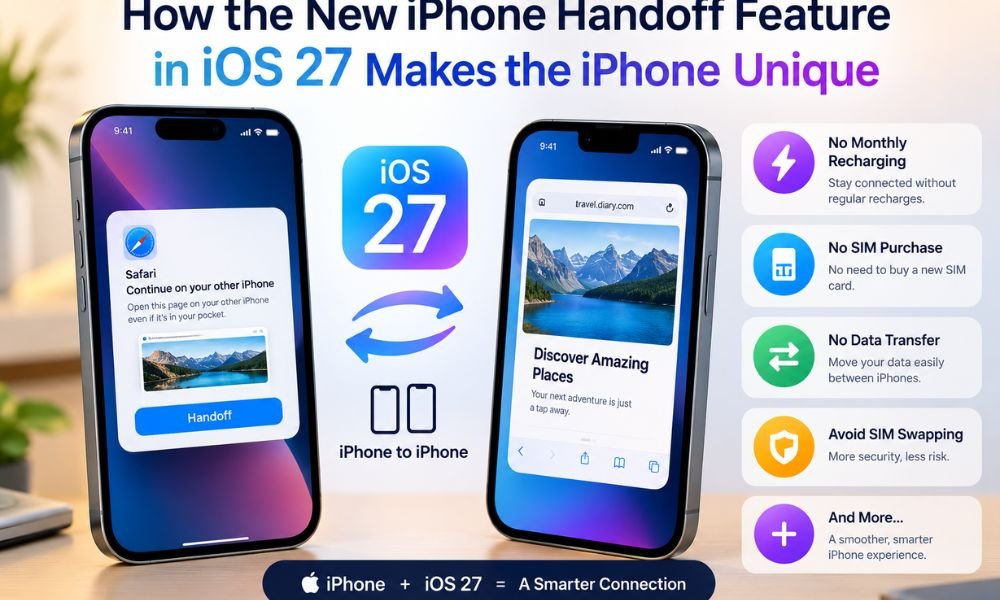
iOS 27 is expected to introduce several exciting new features, but this particular addition could be one of the most noteworthy changes that could make it much easier to use multiple iPhones without managing two separate phone numbers.
The iOS iPhone Handoff feature is designed to let users connect two compatible iPhones to the same cellular line through a primary eSIM and a companion eSIM. The feature was briefly discussed during Apple’s WWDC 2026 keynote and has since been demonstrated in simulated iPhone environments through Xcode 27’s Device Hub.
If Apple and participating carriers enable the feature as expected, users could move their active cellular service between two iPhones without physically swapping SIM cards or setting up an entirely separate cellular plan.
In simple terms, Phone Handoff basically lets a user share one number between two iPhones. This could be particularly useful for people who regularly carry two devices for work, travel, entertainment, or different everyday activities.
The new iPhone Handoff feature is designed to work between compatible iPhones, rather than between an iPhone and an Android smartphone.It is intended for supported iPhone models and requires compatible software and carrier support.
However, iPhone Handoff should not be confused with Apple’s existing Handoff and Continuity features, which allow users to continue activities between an iPhone, iPad, Mac, or Apple Watch. The new feature specifically focuses on using a single phone number between two compatible iPhones through companion eSIM technology.
If you are wondering whether the feature is safe, it is designed around Apple’s existing eSIM and security technologies. However, users should make sure that both iPhones are running supported software and that their carrier officially supports the companion eSIM functionality.
What Is iPhone Handoff in iOS 27?
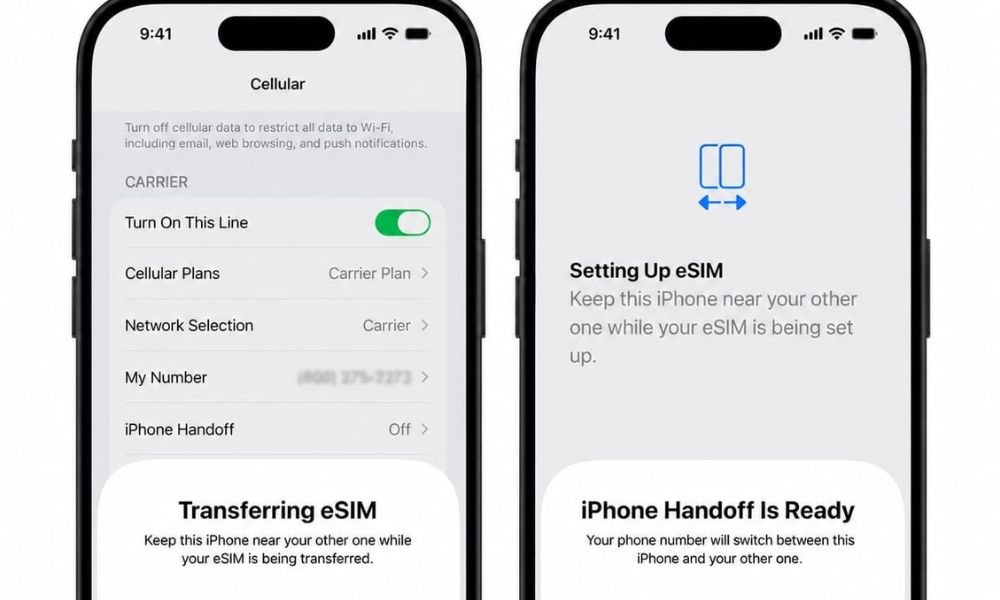
The new iPhone Handoff feature is intended to allow users to utilise a single phone number across two different iPhones. Rather than treating both devices as completely independent cellular devices, one iPhone acts as the main device while the other works as a companion.
The primary iPhone keeps the user’s main eSIM and remains the central device for the cellular subscription. A companion eSIM can then be associated with the second iPhone.
This means users could potentially move their cellular experience from one device to another without manually transferring an eSIM every time they want to switch phones. Both iPhones need to have Wi-Fi and Bluetooth turned on for the Handoff feature to work properly, typically within a range of around 30 feet (10 meters).
For example, imagine that you normally use an iPhone Pro as your main smartphone but prefer carrying a smaller or older iPhone when travelling. With iPhone Handoff, both devices could potentially be connected to the same phone number, making it easier to switch between them.
The feature is particularly interesting because it could make using two iPhones feel more like using two connected extensions of the same cellular line.
How Does iPhone Handoff Work?
The system appears to rely heavily on eSIM technology and carrier support. During setup, users would designate one iPhone as the main device and another as the companion device.
The main eSIM remains associated with the primary iPhone, while a companion eSIM is provisioned for the second device.
Once configured, the two iPhones can work together as part of the same cellular setup. Depending on how the final implementation works, the active device could receive calls, messages and mobile data while the user is interacting with it.
The switching process is designed to be much simpler than manually transferring an eSIM between devices.
A potential example would be:
- The main iPhone is being used normally.
- The user unlocks the companion iPhone.
- The cellular service moves to or becomes active on the companion device.
- Calls, SMS messages and mobile connectivity become available on the companion iPhone.
- When the companion device is locked and the user returns to the main iPhone, service can switch back.
A notification, including a possible Dynamic Island indicator, may inform the user when the cellular connection has transferred. However, some details could still change before the feature reaches its final public release.
Start a Task on One Device and Complete It on Another
One of the most interesting possibilities is the ability to start a task on one device and complete it on another.
Apple already offers several Continuity features that allow users to move activities between Apple devices. iPhone Handoff could take this idea further by making two iPhones more closely connected at the cellular level.
For instance, you could begin your day using your primary iPhone. Later, you might decide to switch to your secondary iPhone because it is smaller, lighter or better suited to a particular activity.
Instead of worrying about whether someone can reach your primary number, the companion device could take over the cellular connection.
This could be particularly convenient for professionals who use one phone for work-related applications and another for personal activities. Rather than maintaining two separate numbers, the same number could potentially remain accessible across both devices.
One Number Between Two iPhones
The biggest advantage of the feature is straightforward: it allows users to utilise a single phone number across two different iPhones.
Traditionally, people who want cellular connectivity on two phones may need separate plans or have to move their SIM or eSIM from one device to another. Some carriers also offer multi-device services, but these may work differently depending on the carrier and plan. iPhone Handoff aims to provide a more integrated Apple experience.
With the main and companion setup, users would not necessarily need to create another phone number simply because they want to use another iPhone. This could make dual-iPhone ownership more practical for users who already own multiple Apple smartphones.
Calls, Messages and Mobile Data
The feature is expected to focus on the most important aspects of cellular connectivity, including calls, SMS messages and mobile data.
If the companion iPhone becomes the active device, users could receive important communications on that phone instead of having to keep checking their primary iPhone.
For people who frequently change devices during the day, this could eliminate one of the biggest inconveniences of owning two phones.
However, the exact behavior of calls, SMS, iMessage, FaceTime and mobile data will depend on Apple’s final implementation and carrier support. Apple’s existing ecosystem services may also continue to play an important role in how communications are synchronized between devices.
Carrier Support Will Be Important
Although the technology could make dual-iPhone usage much easier, carrier support is one of the most important requirements.
A carrier needs to support the companion eSIM system and associate it with the user’s primary cellular subscription. Without carrier-side support, simply running iOS 27 on two iPhones would not necessarily be enough to activate the feature.
T-Mobile in the United States and Deutsche Telekom in Germany have been associated with early support for the technology. Availability may vary by country, carrier, subscription and device, so users should check with their carrier before assuming that iPhone Handoff will work with their plan.
Apple and carriers could also expand support to additional markets after the feature becomes available.
Requirements for iPhone Handoff
Users interested in trying the feature will likely need compatible hardware, software and carrier service.
Potential requirements include:
- Two compatible iPhones.
- Both iPhones are running a supported version of iOS 27.
- eSIM support on both devices.
- A compatible cellular carrier.
- A carrier plan that supports companion eSIM functionality.
- An active primary cellular subscription.
- Appropriate Apple Account and device configuration.
Because iOS 27 is still subject to development and changes, the final requirements could differ from those seen during testing.
Useful for Work and Personal Use
The ios iPhone handoff feature could be particularly useful for people who maintain separate work and personal devices.
For example, someone could keep work applications and documents on one iPhone while using another device for personal activities. Both could potentially remain associated with the same phone number.
It could also be useful for people who prefer different devices for different situations. A user might carry a larger iPhone during normal working hours but choose a smaller device while exercising, travelling or spending time outdoors.
Rather than managing separate phone numbers, the user could switch between the two devices.
A Potential Benefit for Future iPhone Designs
Another interesting possibility is how this feature could complement future iPhone form factors.
Apple could eventually offer devices with very different designs, including compact models or foldable iPhones. A user might want a conventional iPhone for everyday use and a different form factor for specific situations.
A system that makes switching a phone number between devices easier could make these combinations more practical.
Of course, this does not mean that Apple has confirmed any specific future hardware use case. It simply demonstrates how the underlying technology could become useful as Apple’s device ecosystem evolves.
iPhone Handoff vs Traditional eSIM Transfer
Traditional eSIM transfer is designed to move a cellular plan from one compatible device to another. Once transferred, the original device may no longer have the same active cellular connection.
iPhone Handoff is different in concept. Instead of repeatedly transferring the main eSIM, the system is designed around a primary iPhone and a companion iPhone.
This could make switching between devices considerably more convenient.
Users would not need to open cellular settings and perform a full eSIM transfer whenever they wanted to change phones. The companion arrangement could handle the connection in the background, assuming the carrier supports it.
Final Thoughts
The iOS 27 iPhone Handoff feature could become one of Apple’s most useful additions for people who regularly use more than one iPhone. Phone Handoff basically lets a user share one number between two iPhones, potentially eliminating the need to maintain separate numbers or manually move an eSIM whenever switching devices.
The ability to start a task on one device and complete it on another could also make Apple’s Continuity ecosystem more convenient, particularly for users who own multiple iPhones.
This feature is designed for users who have two iPhones.
It works only between iPhone devices and does not support connections between an iPhone and an Android device, primarily due to Apple’s security and ecosystem requirements. The iPhone Handoff feature is available on compatible devices running iOS 26.
However, carrier compatibility will be critical. Not every carrier or cellular plan is expected to support companion eSIM functionality immediately. Users should therefore verify compatibility with their carrier before relying on the feature.
If Apple delivers the feature as demonstrated, iPhone Handoff could make using two iPhones much more seamless. Instead of thinking of them as two completely separate phones, users may be able to treat them as two connected devices sharing the same cellular identity.