
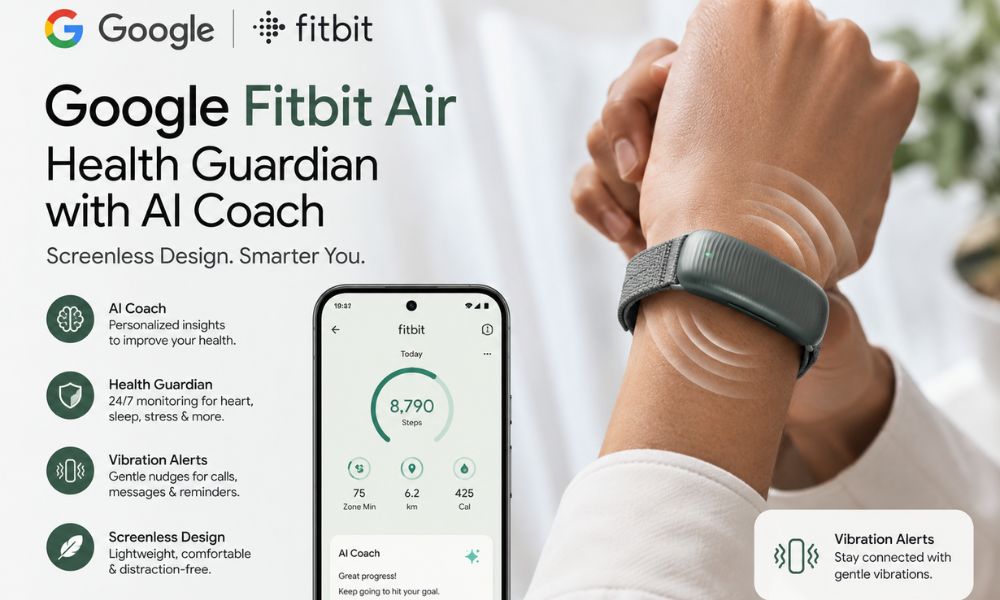
Google is expanding its wearables in India with a new screen-free fitness tracker designed for users who want health and fitness insights without the distractions of a traditional smartwatch. The Google Fitbit Air Smart Fitness Tracker is expected to arrive in India in October 2026, bringing Fitbit’s health-tracking technology in a lightweight and minimalist form factor.
Unlike conventional smartwatches, the Fitbit Air does not feature a display. Instead, it focuses on continuous health monitoring, fitness tracking, 7 days battery life, sleep analysis, and personalized insights through the Google Health ecosystem. It is also compatible with the Apple iPhone or Android
The company has confirmed that Google is bringing its new Fitbit Air fitness tracker to India in October 2026, although the exact launch date and Indian pricing have not yet been revealed. The device has already made its debut in Europe.
Google Fitbit Air Will Be Launch in India in October 2026
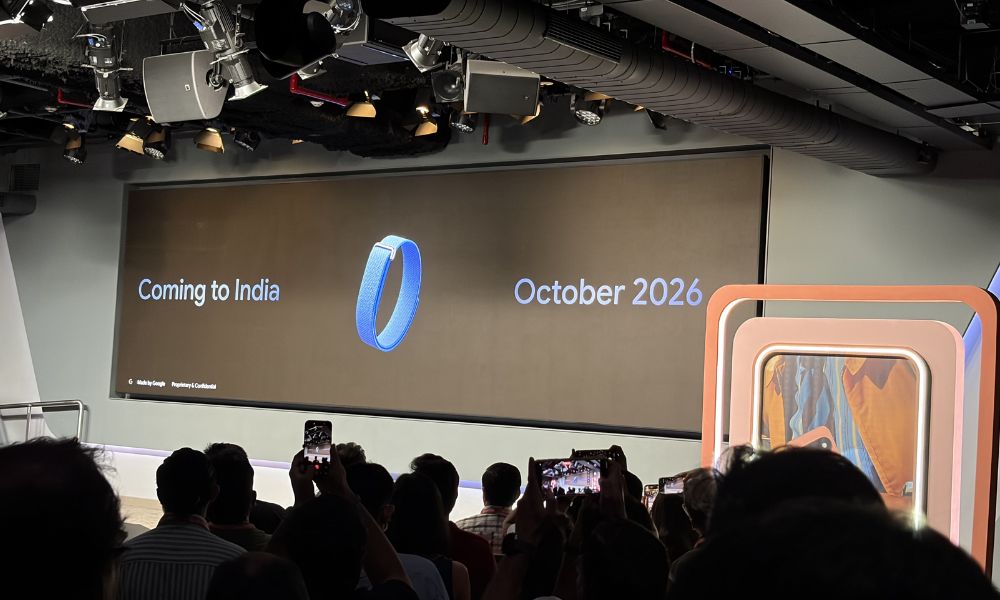
The Google Fitbit Air will be launched in India in October 2026, according to Google’s announced launch plans. However, consumers will have to wait for the exact availability date, pricing, and sales details.
This new wearable is part of Google Fitbit’s family of fitness trackers and smartwatches, but it takes a different approach from conventional Fitbit devices. Instead of offering a screen, apps, notifications, or smartwatch-style functionality, the Fitbit Air is designed primarily around health and fitness monitoring.
This screen-free approach could make it appealing to people who want to wear a fitness tracker throughout the day without constantly checking a display.
Is There Any Plan for Google to Launch Fitbit Air in India?
Yes. If you are wondering, “Is there any plan for Google to launch the Fitbit Air in India,” Google has confirmed an October 2026 launch window for the country. The company has not yet revealed the exact launch date or Indian price. More information is expected closer to the official release.
In the United States, the standard edition is priced at $99.99, while the special edition costs $129.99. So estimation is these prices are approximately ₹13,000 and ₹16,500, respectively. A Fitbit device can be used without a subscription, while users can optionally subscribe to Google Health Premium for additional health and fitness features.
Design: Ultra-Lightweight, Screenless, Distraction-Free Pebble Style
One of the biggest highlights of the Google Fitbit Air Smart Fitness Tracker is its compact and lightweight construction. The tracker weighs approximately 12 grams, making it significantly less noticeable during everyday use.
The wearable follows an ultra-lightweight, screenless, distraction-free pebble style. Most of the band also available screenless trackers like Whoop 5.0, Amazfit Helio Strap, Nowatch. Instead of placing a display on the wrist, the Fitbit Air also has a compact sensor module attached underneath its fabric-based loop band.
The screenless design means users cannot interact with the tracker like a smartwatch. There are no conventional notifications or large display elements competing for attention. Instead, users can check their health and fitness information through the companion health platform.
The stylish band is made of polyurethane with a stainless-steel buckle and clasp. The sensor pod incorporates recycled polycarbonate and PBT plastics, helping maintain a lightweight construction.
For people who prefer wearing a fitness tracker while sleeping, exercising, or working, the low weight could be one of the Fitbit Air’s strongest advantages.
Sensor Module and Health Monitoring
Despite its small size, the Fitbit Air includes several sensors designed for continuous health and activity tracking. The sensor module includes an optical heart-rate monitor, 3-axis accelerometer, gyroscope, SpO2 sensors, a device-temperature sensor, and a vibration motor.
These waterproof silicone material and sensors allow the tracker to collect a variety of health and movement information throughout the day.
24/7 Heart Rate Monitoring
The Fitbit Air can continuously monitor heart rate and provide information such as resting heart rate and heart-rate variability (HRV).
It also supports heart-rhythm monitoring and AFib alerts, giving users additional information about their cardiovascular health. However, these features should be considered wellness and monitoring tools rather than a replacement for professional medical diagnosis.
Blood Oxygen Monitoring
The wearable also includes SpO2 sensors using red and infrared light to monitor blood oxygen levels.
Along with oxygen monitoring, the Fitbit Air can track other health metrics, including resting heart rate and HRV, giving users a broader overview of their daily health patterns.
Sleep Tracking
Sleep tracking is another important part of the Fitbit Air experience. Because the device is lightweight and screen-free, it is designed to remain comfortable during overnight wear. It can monitor sleep duration and different sleep stages, helping users understand their sleeping patterns over time.
For users who do not enjoy wearing a smartwatch while sleeping, a smaller fitness tracker could be a more comfortable alternative. However, when it comes to stress monitoring, dedicated stress tracking is missing.
Workout Tracking with More Than 140 Activities
The Fitbit Air is also designed for fitness enthusiasts. It can automatically identify more than 140 different activities, allowing users to track workouts without manually selecting every exercise.
The combination of the accelerometer, gyroscope, heart-rate sensor, and other hardware enables the device to understand movement and activity patterns. This makes it suitable for everyday activities as well as structured workouts.
Google Health Coach and AI-Powered Insights
One of the more interesting aspects of Google’s new wearable strategy is the integration of AI-powered health guidance. Google’s Fitbit Air works with the Google Health ecosystem, where users can access health and fitness information and receive personalized recommendations.
The Google Health Coach is designed to provide AI-powered guidance based on an individual’s health and fitness data. Advanced features may be available through a premium subscription. However, a subscription is not required to use the core Fitbit features, while users can optionally subscribe to Google Health Premium for additional health and fitness insights.
This could make the Fitbit Air more than a simple step counter. Instead, the collected data can be used to provide personalized insights and recommendations around exercise and daily activity.
Battery Life and Charging
Battery life is another important advantage of the Fitbit Air. The tracker is rated to provide up to seven days of battery life, depending on usage and enabled features. It also supports rapid charging, with approximately five minutes of charging providing around one day of use.
Most competitors, such as the Garmin CIRQA, WHOOP 5.0 Peak, and Noise REP, offer longer battery life of more than 10 days. However, they are slightly more expensive than the Google Fitbit Air.
A week-long battery could be particularly useful for users who want continuous health and sleep tracking without frequently removing their wearable to recharge it.
Connectivity and Compatibility
The Fitbit Air uses Bluetooth 5.0 for connectivity and has an approximate range of 30 feet under suitable conditions. The device supports smartphones running Android 11 or newer and iOS 16.4 or newer, allowing it to work with both major mobile platforms.
Google is also working toward a more unified health experience. Health and fitness information from Fitbit devices is being brought together through Google’s health ecosystem, with the Google Health app expected to eventually play a larger role in replacing the existing Fitbit and Google Fit app experience.
Data Storage and Health Information
The Fitbit Air is designed to retain health and activity information even when the connected smartphone is not immediately available. It can store minute-by-minute motion data for up to seven days and heart-rate information at intervals of approximately every two seconds. This allows users to continue wearing the device throughout the day and sync their information later.
Product Gallery
The Product gallery for the Fitbit Air highlights its compact pebble-style sensor module, fabric-based band, minimalist construction, and screen-free design. The absence of a display gives the tracker a different appearance from conventional smartwatches and many traditional fitness bands. Instead, the focus is on comfort and discreet health monitoring.
For consumers searching for Google Fitbit Air fitness trackers & bands, the Fitbit Air represents Google’s move toward a simpler category of wearable that prioritizes health data over smartwatch functionality.
Water Resistance
Fitbit is water resistant up to 50 meters, making it suitable for activities such as swimming and everyday exposure to water. However, it is not designed for deep-water activities such as scuba diving, high-pressure water exposure, or prolonged underwater use.
Its IP68 rating also indicates a high level of protection against dust and water ingress under specified testing conditions, but it does not mean the device is suitable for every type of water activity. Always follow specific water-resistance guidelines for the model you are using.
32 Languages and Google’s Wider Health Ecosystem
Google is also expanding the accessibility of its health and AI ecosystem, with support extending across 32 languages. This could make Google’s health-focused services more accessible to users across different regions and markets.
The integration of Fitbit technology with Google’s broader health ecosystem is particularly important because the company is moving toward a more unified approach to fitness, wellness, and AI-powered health guidance.
Google Is Expanding Its Wearables in India
The arrival of the Fitbit Air is another indication that Google is expanding its wearables in India. India already has a large and competitive smartwatch and fitness-band market, with consumers increasingly interested in health monitoring, sleep tracking, heart-rate measurement, and fitness insights.
However, the Fitbit Air takes a different approach. Rather than competing directly with full-featured smartwatches, it focuses on people who want a lightweight wearable that can remain on the wrist throughout the day without a screen.
Is the Fitbit Air Worth Considering?
The Fitbit Air could be an interesting option for users who prioritize comfort, health tracking, and battery life over smartwatch features. Its major strengths include a 12-gram lightweight design, screen-free construction, continuous heart-rate monitoring, SpO2 tracking, sleep monitoring, automatic activity recognition, AI-powered health insights, and up to seven days of battery life.
It lacks built-in GPS, but you can use your connected smartphone’s GPS to track your location and activities. Its bandwidth size is just under 18 mm wide. However, users who want notifications, apps, calls, maps, music controls, or a smartwatch display may prefer a conventional smartwatch instead.
The Fitbit Air is designed for a different audience—people who want their wearable to collect health and fitness information without becoming another screen they need to check throughout the day.
Final Thoughts
The lightest smart wearable approach makes the Fitbit Air an interesting addition to Google’s wearable portfolio. Its screenless pebble design, lightweight construction, comprehensive health sensors, sleep tracking, automatic workout recognition, and AI-powered guidance give it a clear identity.
With Google bringing its new Fitbit Air fitness tracker to India in October 2026, Indian consumers will soon have another option in the growing fitness-tracker segment. The exact launch date and Indian pricing are still awaited, but the device’s focus on comfort and continuous health monitoring could make it appealing to users who do not need a traditional smartwatch.
Overall, the Google Fitbit Air Smart Fitness Tracker is positioned as a simple, lightweight, and health-focused wearable. For users who want fitness tracking without the distraction of a screen, Google’s new device could be an interesting alternative to conventional smartwatches and display-based fitness bands.