
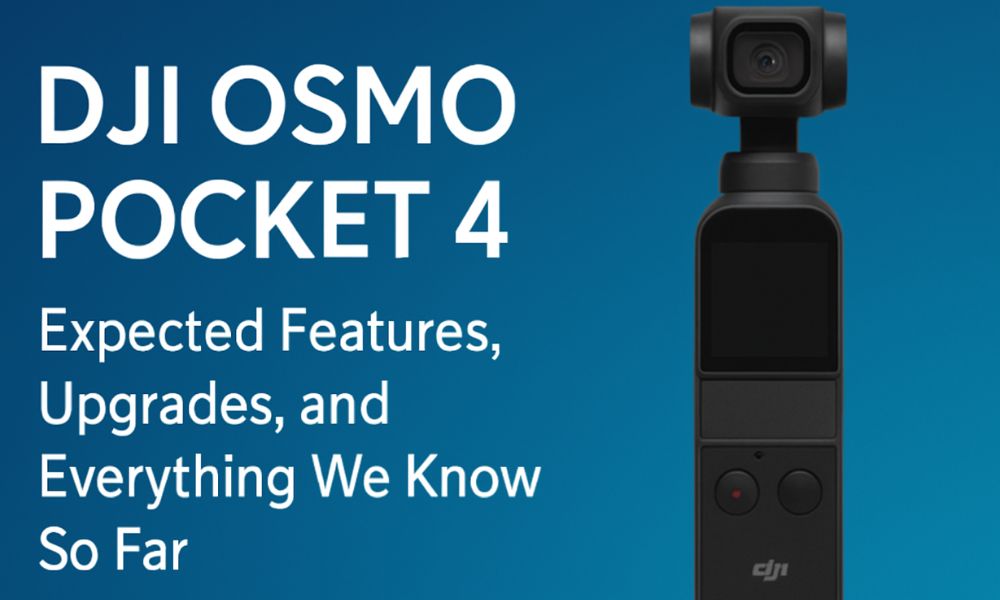
DJI Osmo Pocket series has established a good presence in the compact camera segment, especially among vloggers, travel content creators, and mobile film-makers in need of a professional-grade filming experience in a pocket-sized device. With the overwhelming response to the Osmo Pocket 3, now begins the anticipation for a new product named DJI Osmo Pocket 4.
Although DJI hasn’t unveiled the device yet, information available to us from leaks and DJI’s previous product update pattern make it quite easy to estimate what can be expected in the next model. Osmo Pocket 4,” if true, will be a major step forward in camera capabilities, image stability, and smarts.
Expected Camera Sensor Improvements
The camera of the DJI Osmo Pocket 4 is one of the most talked-about enhancements. Most expect it to have a more advanced 1-inch CMOS camera sensor than the prior generation. The anticipated refinement of the camera sensor will improve the amount of light captured greatly, which means that the expected benefits include a dramatic improvement in low-light performance, reduced noise and enhanced night image quality.
The increase in sensor size and technology is designed to benefit creators who shoot their content indoors or at night and during “golden-hour” conditions.
Moreover, it is likely that the increased sensor size and technology will also improve the dynamic range of captured images, allowing for more detail to be captured in both highlight and shadow areas to create cinematic-quality video.
Video Recording Capabilities and Performance
The Osmo Pocket series has always been known for its ability to produce high-quality videos, and DJI is expected to raise the bar with its latest model, the Osmo Pocket 4. According to some leaks, it appears that DJI will also be introducing 4K video recording capabilities to the Osmo Pocket 4 with up to 120 frames per second frame rates.
This will allow for much smoother slow-motion videos while keeping the same level of detail and quality. For example, this would allow people capturing travel vlogs and action shots to produce much more professionally.
Dji is also expected to have improved high dynamic range (HDR) video processing technology, resulting in better colour fidelity and equalised lighting conditions regardless of where the user is shooting.
Additionally, DJI is also expected to improve its colour science, which will produce natural-looking skin tones with richer colours straight out of the box and will require much less work to enhance in post-production than previous models.
Next-Generation AI Tracking and Smart Features
DJI is likely to excel in artificial intelligence with the launch of the Osmo Pocket 4, given how much they have advanced their ActiveTrack technology.
Their current iteration provides a good deal of accuracy and reliability with regards tracking objects by using artificial intelligence, and as per rumors regarding the new model of the Osmo Pocket, expect even more intelligence, face recognition capabilities and movement detection, even when things may seem very hectic or there is a large number of people around.
This feature will certainly prove very useful to individual vloggers who need automatic reframing of shots while filming themselves, as well as who want to have the option of being more hands-free while shooting video, improved Gesture controls and the ability to perform a smarter lock on subjects will also aid assistants in filming and recording multiple subjects at once without leaving them with anything to press.
Enhanced 3-Axis Gimbal Stabilization
One of the biggest strengths of DJI is its stabilization, and the Osmo Pocket 4 is expected to feature an upgraded 3-axis mechanical gimbal system. The improved gimbal system could provide quicker response times and even better horizon leveling for smooth footage when making sudden movements or with uneven walking.
This would really further reduce jitters and unwanted shakes, making the camera ideal for travels, daily vlogs, or action-oriented content. Better stabilization algorithms working along with the physical gimbal mean consistently smooth footage without additional accessorial aids.
Improved Audio Quality and Microphone Support
While video quality is important, the audio quality is equally as important to DJI and the DJI has been focusing more on audio performance with their newer devices. The Osmo Pocket 4 is expected to have an Enhanced Multi-Microphone System which will give clearer audio recording of voice and better Wind Noise Cancellation.
These improvements will be especially useful for Outdoor Recording and Travel Vlogs!! In addition, there will be an option to deeply integrate with the DJI Mic 2 and many other types of Wireless Mic Systems for seamless pairing and better audio synchronisation. This should benefit many creators that want to get professional audio without additional equipment.
Battery Life and Charging Enhancements
As with other aspects of the Osmo Pocket 4, improvements made to battery performance are both incremental in nature and significant enough to be of benefit for consumers.
Current expectation from early reports on the DJI Osmo Pocket 4 is a 15-20% increase in battery life, compared to the previous model, which allows for greater amount of time available between charges, making it convenient for users to record video without needing to frequently recharge while they are traveling or covering events.
Faster charging capability through the USB-C port appears to be another added feature of the Osmo Pocket 4, making it possible for users to quickly charge the battery to continue shooting video. Additionally, becoming more energy efficient when recording high-resolution video will provide even longer operational times for real-world use on the Osmo Pocket 4.
Display, Interface, and User Experience
The anticipated release of the Osmo Pocket 4 will include a more intuitive UI and enhanced touchscreen display. New features of the improved Rotating touchscreen include improved brightness and responsiveness to allow for the maximum visibility when filming in bright outdoor conditions, as well as smoother menus for faster navigation through available camera settings.
The company has said it will create UI optimizations to speed up the process of switching between shooting modes, frame rate options and tracking modes. While individually these refinements may seem minimal, collectively they create a much more favourable shooting environment overall for content creators who rely on real-time adjustments to their workflows.
Connectivity and File Transfer Improvements
Connectivity is key with modern-day content creation, so it is expected that DJI improves this in the Osmo Pocket 4. Faster and more stable Wi-Fi and Bluetooth connectivity could provide smoother pairing options with smartphones and more reliable control from the DJI Mimo app.
Better wireless performance would also afford quicker file transfers, allowing a user to edit and then share their content right after recording. If a social media creator values speed and ease above all else, these may prove to be very valuable upgrades.
Should You Wait for DJI Osmo Pocket 4?
While the DJI Osmo Pocket 4 has not been officially confirmed, the expected upgrades suggest it could be a powerful tool for both beginners and professional creators. If you already own an Osmo Pocket 3 and are satisfied with its performance, waiting for official details may be a smart choice.
However, for those looking to invest in the latest technology with better low-light performance, smarter tracking, and enhanced stabilization, the Osmo Pocket 4 could be worth the wait. Until DJI makes an official announcement, all information should be treated as speculative, but the future of the Osmo Pocket lineup looks promising.
FAQ
Is DJI Osmo 4 waterproof?
DJI Osmo 4, which is generally a name given to DJI OM 4 smartphone gimbal, is not waterproof. The device is meant for vlogging and capturing stabilized videos using smartphones but lacks waterproofing or an IP rating. Use of DJI OM 4 in rain, water splashes, or under water can lead to damage to its internals such as motors and electronics. Devices such as GoPro or DJI Osmo Action cameras with waterproofing can be used in case waterproofing is a necessity.
Is the DJI camera better than GoPro?
Whether a DJI camera is better than a GoPro camera or not largely depends on your usage in content production. While DJI cameras, including Osmo Pocket series, have a focus on cinematic video quality, excellent image stabilization thanks to gimbal cameras, and fantastic performance in low-light environments, GoPro cameras have a focus on action shots in rough and tough environments with waterproof cameras. While a DJI camera is considered better for vlogging, travel, or a smoothened film sight, a GoPro is better for adventure sports and underwater shooting.
Is a zoom function available in the DJI Osmo Mobile 4?
DJI OM 4 lacks an optical zoom facility because it is a gimbal for smartphones and not a camera. However, it is possible to make use of the digital zoom facility available in the camera application of your smartphone when you are using the gimbal. The digital zoom facility available in the DJI OM 4 gimbal will solely depend on your smartphone camera.
Which types of mobile devices are compatible with DJI OM 4 Gimbals?
The DJI OM 4 is compatible with a wide range of Android and iOS smartphones. It supports most modern iPhones, including iPhone 8 and newer models, as well as many popular Android devices from brands such as Samsung, Xiaomi, OnePlus, Vivo, Oppo, and Realme.
Phones must meet size and weight requirements, typically between 170–290 grams, and should run Android 8.0 or later, or iOS 11 or later. Compatibility may vary depending on the DJI Mimo app support.
How long can I expect my DJI OM 4 battery to last?
Battery life for the DJI OM 4 is expected to last from 10 to 15 full hours of operation when charged under optimal conditions. Many factors affect actual usage and performance; some of these include the weight of your mobile device, which active shooting features you select, and how long you shoot continuously versus throughout the entire shooting session. Battery charging occurs via a USB-C connector with a built-in rechargeable Li-Ion battery located on the DJI OM 4.
The time to fully charge your OR 4’s battery is approximately 2.5 hours. Because the DJI OM 4 has a long battery life, it offers an ideal solution for full-day vlogging, which requires continuous video recording and extended periods, as well as supporting video recording on very long-duration shoots.